War scythe
Videos
A war scythe or military scythe is a form of polearm with a curving single-edged blade with the cutting edge on the concave side of the blade. Its blade bears a superficial resemblance to that of an a
Illustration from Chrystian Piotr Aigner's "Krótka nauka o kosach i pikach" ("A Brief Treatise on Scythes and Pikes"), 1794


17th century Scottish war scythe

Scythemen during Poland's January 1863 Uprising

The Death of Bara (Jean-Joseph Weerts, 1883), depicting the use of the war scythe
Fauchard
Videos
A fauchard is a type of polearm which was used in Europe from the 11th through the 17th centuries. In later use fauchards became ornamental and ceremonial, growing in size until some examples were alm
War scythe
…thin and irregularly curved blades, specialised for mowing grass and wheat only, unsuitable as blades for improvised spears or polearms. Compared to a fauchard (which is believed to have evolved from the war scythe), the blade of the war scythe has the cutting edge on the concave side like the agricultural…

"Coupe-marc", a French agricultural tool from the 19th or 20th century, often mislabeled as a fauchard. Most polearms originated from pole-mounted agricultural tools because of their heft and reach.

Soldiers with various polearms including a fauchard and glaive

Weapons in a French museum, illustrating differing name usage between languages. Left: A weapon called a fauchard, resembling a bill. Right: An ornate crescent-bladed halberd labelled "partisan".
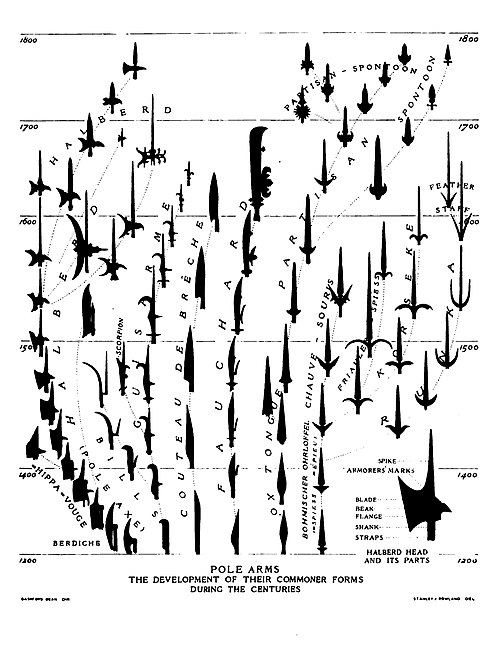
Pole Arms: The Development of Their Commoner Forms During the Centuries (fauchards are near the middle)