The Warsaw Ghetto was the largest of the Nazi ghettos during World War II and the Holocaust. It was established in November 1940 by the German authorities within the new General Government territory of occupied Poland. At its height, as many as 460,000 Jews were imprisoned there, in an area of 3.4 km2 (1.3 sq mi), with an average of 9.2 persons per room, barely subsisting on meager food rations. Jews were deported from the Warsaw Ghetto to Nazi concentration camps and mass-killing centers. In the summer of 1942, at least 254,000 ghetto residents were sent to the Treblinka extermination camp during Großaktion Warschau under the guise of "resettlement in the East" over the course of the summer. The ghetto was demolished by the Germans in May 1943 after the Warsaw Ghetto Uprising had temporarily halted the deportations. The total death toll among the prisoners of the ghetto is estimated to be at least 300,000 killed by bullet or gas, combined with 92,000 victims of starvation and related diseases, the Warsaw Ghetto Uprising, and the casualties of the final destruction of the ghetto.
Brick wall of the Warsaw Ghetto dividing the Iron-Gate Square, with view of bombed out Lubomirski Palace (left) on the "Aryan" side of the city, May 24, 1941.
Karmelicka Street 11 from Nowolipia September/October 1939
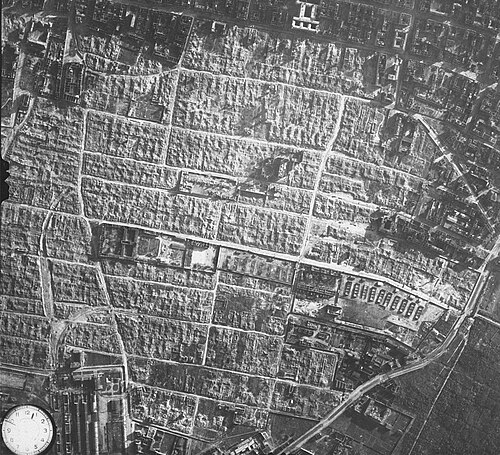
Aerial photograph of the northern Warsaw Ghetto area after its destruction, probably 1944
Roundup of Jewish men for forced labor by the Order Police battalions, Krakowskie Przedmieście, March 1940
Treblinka was the second-deadliest extermination camp to be built and operated by Nazi Germany in occupied Poland during World War II. It was in a forest north-east of Warsaw, 4 km (2.5 mi) south of the village of Treblinka in what is now the Masovian Voivodeship. The camp operated between 23 July 1942 and 19 October 1943 as part of Operation Reinhard, the deadliest phase of the Final Solution. During this time, it is estimated that between 700,000 and 900,000 Jews were murdered in its gas chambers, along with 2,000 Romani people. More Jews were murdered at Treblinka than at any other Nazi extermination camp apart from Auschwitz-Birkenau.
Concrete blocks marking the path of the former railway spur at Treblinka
Official announcement of the founding of Treblinka I, the forced-labour camp
Memorial at Treblinka II, with 17,000 quarry stones symbolising gravestones. Inscriptions indicate places of Holocaust train departures, which carried at least 5,000 victims each, and selected ghettos from across Poland.
The 1944 aerial photo of Treblinka II after efforts at "clean-up", or disguising its role as a death camp. The new farmhouse and livestock building are visible to the lower left. The photograph is overlaid with outlines of already-dismantled structures (marked in red/orange). On the left are the SS and Hiwi (Trawniki) guards' living quarters (1), with barracks defined by the surrounding walkways. At the bottom (2) are the railway ramp and unloading platform (centre), marked with the red arrow. The "road to heaven"