Watt steam engine
Videos
The Watt steam engine was an invention of James Watt that was a driving force of the Industrial Revolution. According to the Encyclopædia Britannica, it was "the first truly efficient steam engine".
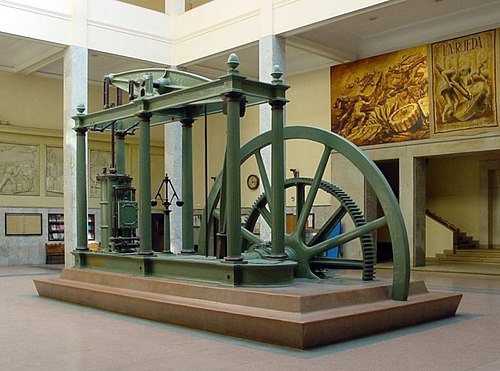
A late version of a Watt double-acting steam engine, built by D. Napier & Son (London) in 1832, now in the lobby of the Superior Technical School of Industrial Engineers of the UPM (Madrid). Steam engines of this kind propelled the Industrial Revolution in Great Britain and the world.
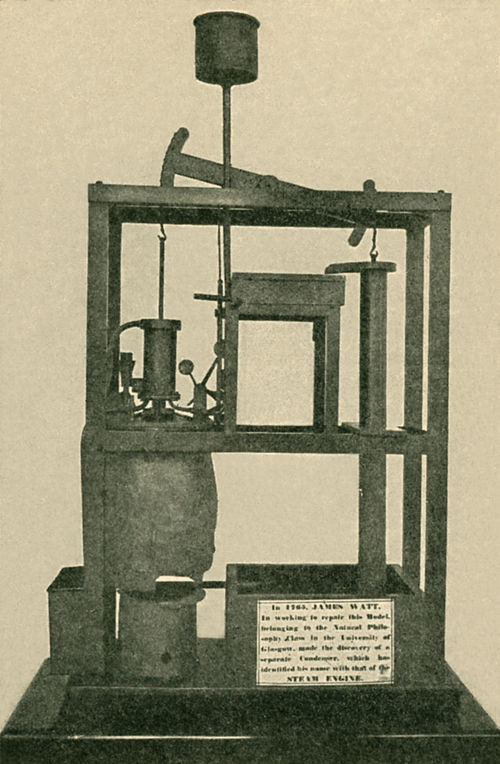
The model Newcomen engine upon which Watt experimented
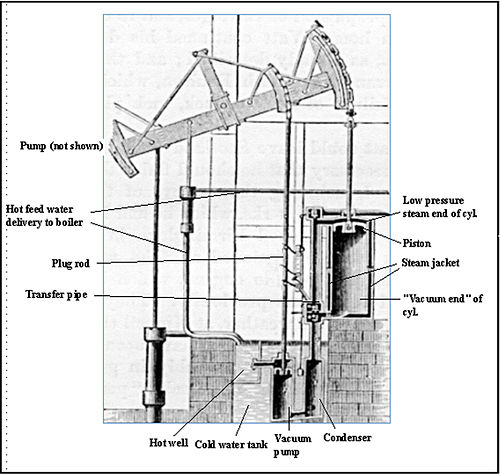
The major components of a Watt pumping engine

Watt's parallel motion on a pumping engine in Freiberg in Germany
Newcomen atmospheric engine
Videos
The atmospheric engine was invented by Thomas Newcomen in 1712, and is sometimes referred to as the Newcomen fire engine or Newcomen engine. The engine was operated by condensing steam being drawn int
Watt steam engine
…Revolution. According to the Encyclopædia Britannica, it was "the first truly efficient steam engine". The Watt steam engine was inspired by the Newcomen atmospheric engine, which was introduced by Thomas Newcomen in 1712. At the end of the power stroke, the weight of the object being moved by the engine pulled the piston…

Newcomen engine as depicted on a 2/- note of the Province of New York, 1775

Pencil sketch of Newcomen steam engine as improved by Smeaton, from Popular Science monthly circa 1877

Newcomen-style engine at the Elsecar Heritage Centre in Barnsley, South Yorkshire

Caprington Colliery Newcomen engine in the National Museum of Scotland in Edinburgh