Week
Videos
A week is a unit of time equal to seven days. It is the standard calendrical period between a day and a month in most parts of the world. There are just over 52 weeks in a year, or on average 4+1⁄3 we

An Italian cameo bracelet representing the days of the week by their eponymous deities (mid-19th century, Walters Art Museum)

Circular diagrams showing the division of the day and of the week, from a Carolingian ms. (Clm 14456 fol. 71r) of St. Emmeram Abbey. The week is divided into seven days, and each day into 24 hours, 96 puncta (quarter-hours), 240 minuta (tenths of an hour) and 960 momenta (40th parts of an hour).

Soviet calendar, 1930. Five colors of five-day work week repeat.
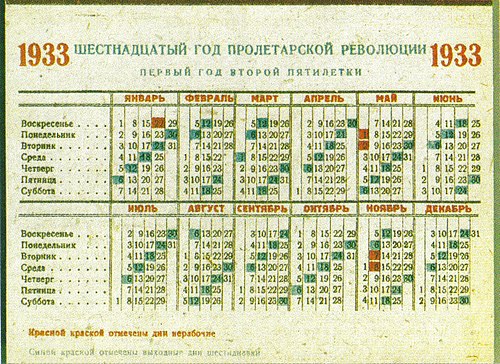
Soviet calendar, 1933. Rest day of six-day work week in blue.
Workweek and weekend
Videos
The weekdays and weekend are the complementary parts of the week, devoted to labour and rest, respectively. The legal weekdays, or workweek, is the part of the seven-day week devoted to working. In mo
Week
…of the week are often used to set work days, rest days, and holy days. The term "week" is also used to refer to a sub-section of the week, such as the workweek and weekend. Certain weeks within a year may be designated for a particular purpose, such as Golden Week in China and Japan. More informally, certain groups may…

This day planner chart (which can be used for any months) shows the workweek days as white boxes and the weekend days as light blue-coloured boxes.