Welfare
Videos
Welfare, or commonly social welfare, is a type of government support intended to ensure that members of a society can meet basic human needs such as food and shelter. Social security may either be synonymous with welfare, or refer specifically to social insurance programs which provide support only to those who have previously contributed, as opposed to social assistance programs which provide support on the basis of need alone. The International Labour Organization defines social security as covering support for those in old age, support for the maintenance of children, medical treatment, parental and sick leave, unemployment and disability benefits, and support for sufferers of occupational injury.

A family support centre in Saint Peter Port, Guernsey, which provides assistance to families with children

Distributing alms to the poor, abbey of Port-Royal des Champs c. 1710

An office of the Social Insurance Institution (KELA) in Seinäjoki, Finland
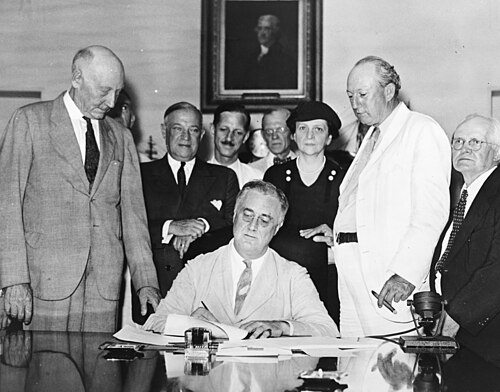
President Roosevelt signs the Social Security Act, 14 August 1935.
Nordic model
Videos
The Nordic model comprises the economic and social policies as well as typical cultural practices common in the Nordic countries. This includes a comprehensive welfare state and multi-level collective bargaining based on the economic foundations of social corporatism, and a commitment to private ownership within a market-based mixed economy – with Norway being a partial exception due to a large number of state-owned enterprises and state ownership in publicly listed firms.

Flags of the Nordic countries, from left to right: Finland, Iceland, Norway, Sweden, and Denmark

Vote percentage over time of the main social democratic parties in Denmark, Finland, Sweden, and Norway Labour Party (Norway) Swedish Social Democratic Party Social Democrats (Denmark) Social Democratic Party of Finland