West Berlin
Videos
West Berlin was a political enclave which comprised the western part of Berlin from 1948 until 1990, during the Cold War. Although West Berlin was de jure not part of West Germany, lacked any sovereig
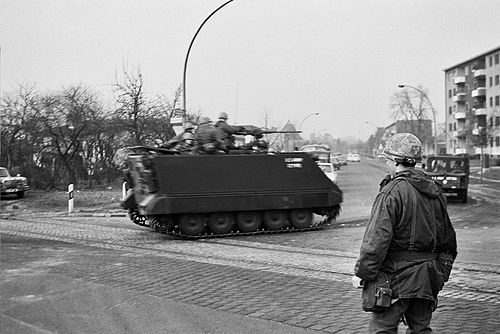
U.S. military vehicles pass through the residential district of Zehlendorf in 1969.

West Berlin auxiliary identity card, bearing the words "The holder of this identity card is a German national" in German, French and English

President John F. Kennedy addressing the people of West Berlin from Rathaus Schöneberg on Rudolf-Wilde-Platz (today's John-F.-Kennedy-Platz), 26 June 1963

President Reagan speaking in front of the Brandenburg Gate giving the "Tear down this wall!" speech in 1987
Berlin Wall
Videos
The Berlin Wall was a guarded concrete barrier that encircled West Berlin from 1961 to 1989, separating it from East Berlin and the German Democratic Republic. Construction of the Berlin Wall was comm
West Berlin
…from West Germany by narrow rail and highway corridors. It consisted of the American, British, and French occupation sectors established in 1945. The Berlin Wall, built in 1961, physically separated West Berlin from both the eastern half of the city and its hinterland in Brandenburg, until it fell in 1989. On 3…

From the West Berlin side, Berlin Wall graffiti art in 1986. The wall's "death strip", on the east side of the Wall, here follows the curve of the Luisenstadt Canal (filled in 1932).

East German Combat Groups of the Working Class close the border on 13 August 1961 in preparation for the Berlin Wall construction

East German construction workers building the Berlin Wall, 20 November 1961

US President John F. Kennedy visiting the Berlin Wall on 26 June 1963