Whist
Videos
Whist is a classic English trick-taking card game that was widely played in the 18th and 19th centuries. Although the rules are simple, there is scope for strategic play.
A 19th-century whist marker by the British printing Co. De La Rue


Drawing by Marguerite Martyn for the St. Louis Post-Dispatch of a session of the Women's Whist Club Congress, April 1906, in St. Louis, Missouri
Contract bridge
Videos
Contract bridge, or simply bridge, is a trick-taking card game using a standard 52-card deck. In its basic format, it is played by four players in two competing partnerships, with partners sitting opp
Whist
…American system of leads and signals was adopted in the last edition of Cavendish. In the early 1890s, Whist was quickly replaced by the new game of Bridge in clubs. Whist was still played as a social game, in club individual duplicate cardplay competitions, and later at charitable social events called…

Bridge declarer play

Bridge club at Shimer College, 1942

In this trick, North led ♠10 so all players must play a spade unless they have none. East "follows suit" with ♠K, South with ♦J and West with ♥7. In a no-trump game, East wins the trick, having played the highest spade. If diamonds or hearts are trumps, South or West respectively win.
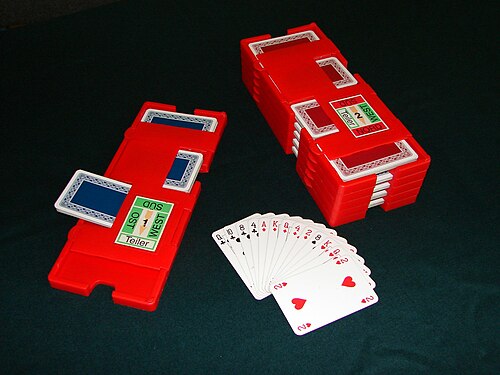
Duplicate Boards with cards