White horses in mythology
Videos
White horses have a special significance in the mythologies of cultures around the world. They are often associated with the sun chariot, with warrior-heroes, with fertility, or with an end-of-time saviour, but other interpretations exist as well. Both truly white horses and the more common grey horses, with completely white hair coats, were identified as "white" by various religious and cultural traditions.

The 3,000-year-old Uffington White Horse hill figure in England.
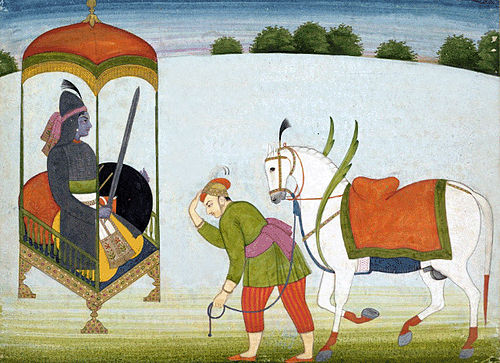
The Hindu world saviour Kalki with his white Horse. Punjab Hills, Guler, c. 1765.

Bellerophon riding Pegasus

The Tjängvide image stone is thought to show Odin entering Valhalla riding on Sleipnir.
White horse
Videos
A white horse is born predominantly white and stays white throughout its life. A white horse has mostly pink skin under its hair coat, and may have brown, blue, or hazel eyes. "True white" horses, especially those that carry one of the dominant white (W) genes, are rare. Most horses that are commonly referred to as "white" are actually "gray" horses whose hair coats are completely white. Gray horses may be born of any color and their hairs gradually turn white as time goes by and take on a white appearance. Nearly all gray horses have dark skin, except under any white markings present at birth. Skin color is the most common method for an observer to distinguish between mature white and gray horses.

Dominant purebred white stallion

True white horses have pink skin and white coats, and many have dark eyes, as here.

This white Thoroughbred carries W14, one of the forms of dominant white.

This "white-born" or "fewspot" Appaloosa foal has a mostly pink-skinned white coat.