The Wide Field and Planetary Camera 2 is a camera formerly installed on the Hubble Space Telescope. The camera was built by the Jet Propulsion Laboratory and is roughly the size of a baby grand piano.

Brought back to Earth by the U.S. Space Shuttle, the WFPC is loaded for transport after display at JPL on its way to its final home at the National Air and Space Museum in 2010

Picture of small section of the Carina Nebula created from images taken with Hubble's Wide Field Planetary Camera 2.

Hubble Space Telescope WFPC2 image of the Hubble Deep Field showing the characteristic stairstep composition of WFPC2 images
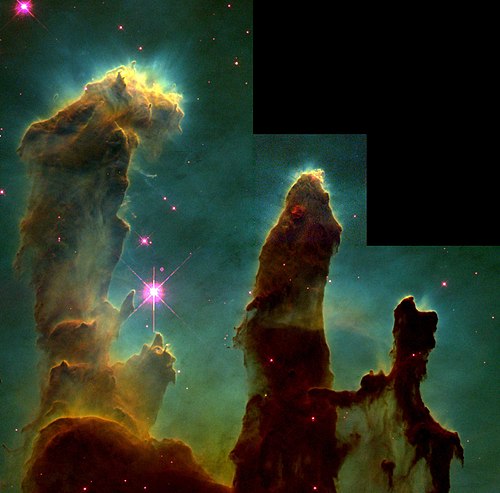
The Pillars of Creation within the Eagle Nebula
Hubble Deep Field
Videos
The Hubble Deep Field is an image of a small region in the constellation Ursa Major, constructed from a series of observations by the Hubble Space Telescope. It covers an area about 2.6 arcminutes on
Wide Field and Planetary Camera 2
…installed by servicing mission 1 (STS-61) in 1993, replacing the telescope's original Wide Field and Planetary Camera (WF/PC). WFPC2 was used to image the Hubble Deep Field in 1995, the Engraved Hourglass Nebula and Egg Nebula in 1996, and the Hubble Deep Field South in 1998. During STS-125, WFPC2 was removed and replaced…

The Hubble Deep Field

The dramatic improvement in Hubble's imaging capabilities after corrective optics were installed encouraged attempts to obtain very deep images of distant galaxies.

Diagram illustrating comparative sampling distance of the HDF and the 2004 Hubble Ultra-Deep Field

A section of the HDF about 14 arcseconds across in each of the four wavelengths used to construct the final version: 300 nm (top left), 450 nm (top right), 606 nm (bottom left) and 814 nm (bottom right)