William Oughtred
Videos
William Oughtred, also Owtred, Uhtred, etc., was an English mathematician and Anglican clergyman. After John Napier discovered logarithms and Edmund Gunter created the logarithmic scales upon which sl
William Oughtred engraving by Wenceslaus Hollar


The Caryll home at Great Tangley

Old St Peter and St Paul's Church, Albury, Surrey, where William Oughtred was rector from 1610 to 1660, and where he is buried.

An instrument for Oughtred's "Circles of Proportion", by Elias Allen, c. 1633–1640 (Harvard University, Putnam Gallery)
John Napier
Videos
John Napier of Merchiston, nicknamed Marvellous Merchiston, was a Scottish landowner known as a mathematician, physicist and astronomer. He was the 8th Laird of Merchiston. Napier is best known as the
William Oughtred
…William Oughtred ( AWT-ed;5 March 1574 – 30 June 1660), also Owtred, Uhtred, etc., was an English mathematician and Anglican clergyman. After John Napier discovered logarithms and Edmund Gunter created the logarithmic scales (lines, or rules) upon which slide rules are based, Oughtred was the first to…

1616 portrait of Napier

Merchiston Castle from an 1834 woodcut
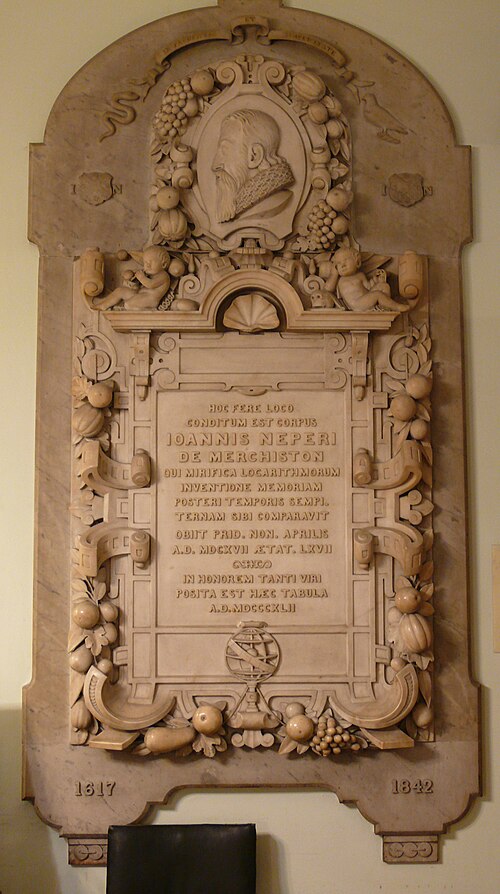
Memorial to John Napier in St Cuthbert's Church, Edinburgh

Cover of Mirifici logarithmorum canonis descriptio (1614)