Williams tube
Videos
The Williams tube, or the Williams–Kilburn tube named after British inventors Freddie Williams and Tom Kilburn, is an early form of computer memory. It was the first random-access digital storage devi

A Williams (or Williams-Kilburn) tube on display at The National Museum of Computing on Bletchley Park, Buckinghamshire

James Pomerene with a Williams–Kilburn tube, a 5CP1A cathode ray tube, used in the memory array of the IAS computer c. 1951

Williams–Kilburn tube from an IBM 701 at the Computer History Museum, in Mountain View, California

Memory pattern on SWAC Williams tube CRT
Cathode ray tube
Videos
A cathode ray tube is a vacuum tube containing one or more electron guns, which emit electron beams, which are directed and controlled to display images on a phosphorescent screen. The images may repr
Williams tube
…random-access digital storage device, and was used successfully in several early computers. The Williams tube works by displaying a grid of dots on a cathode-ray tube (CRT). Due to the way CRTs work, this creates a small charge of static electricity over each dot. The charge at the location of each of the dots is…

Oscilloscope cathode ray tube

A Macintosh computer from the 1990s with integrated CRT display
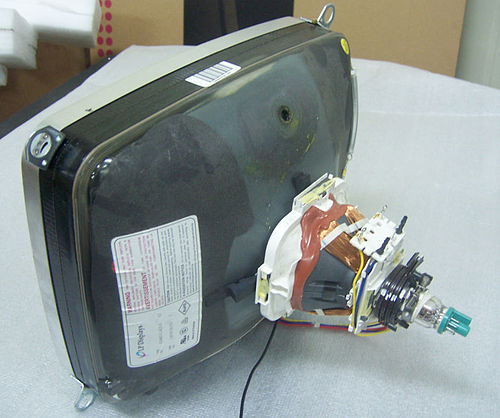
The rear of an LG.Philips Displays 14-inch color cathode ray tube showing its deflection coils and electron guns

Typical 1950s United States monochrome CRT TV