Woman's club movement in the United States
The woman's club movement was a social movement that took place throughout the United States that established the idea that women had a moral duty and responsibility to transform public policy. While women's organizations had existed earlier, it was not until the Progressive era (1896–1917) that they came to be considered a movement. The first wave of the club movement during the progressive era was started by white, middle-class, Protestant women, and a second phase was led by African-American women.
Five women officers of the Women's League in Newport, Rhode Island, c. 1899
The headquarters of the Minnesota Federation of Women's Clubs in Minneapolis, c. 1920
Eartha White (center, first row) is pictured with delegates at the State Meeting of the City Federation of Colored Women's Clubs of Jacksonville, at Palatka, Florida – May 16, 1915.
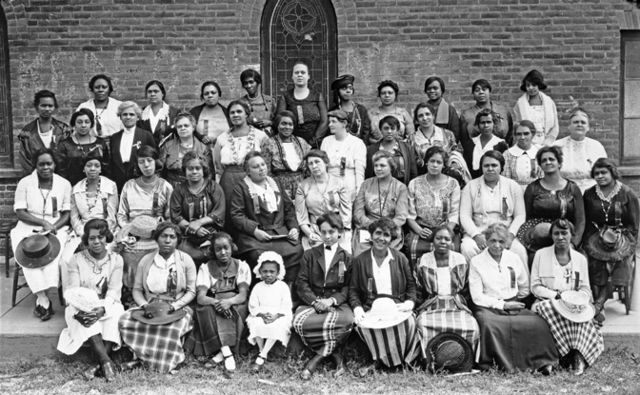
First Convention of the Montana Federation of Negro Women's Clubs, Butte, Montana, August 3, 1921
Social housekeeping, also known as municipal or civil housekeeping, was a socio-political movement that occurred primarily through the 1880s to the early 1900s in the Progressive Era around the United States.
Jane Addams on U.S. Postage Stamp
Hull House
Julia Lathrop, Jane Addams, and Mary McDowell in Washington
Rheta Childe Dorr with the first edition of "The Suffragist"