X-ray
Videos
An X-ray is a form of high-energy electromagnetic radiation with a wavelength shorter than those of ultraviolet rays and longer than those of gamma rays. Roughly, X-rays have a wavelength ranging from

Natural color X-ray photogram of a wine scene. Note the edges of hollow cylinders as compared to the solid candle.

Example of a Crookes tube, a type of discharge tube that emitted X-rays

Wilhelm Röntgen
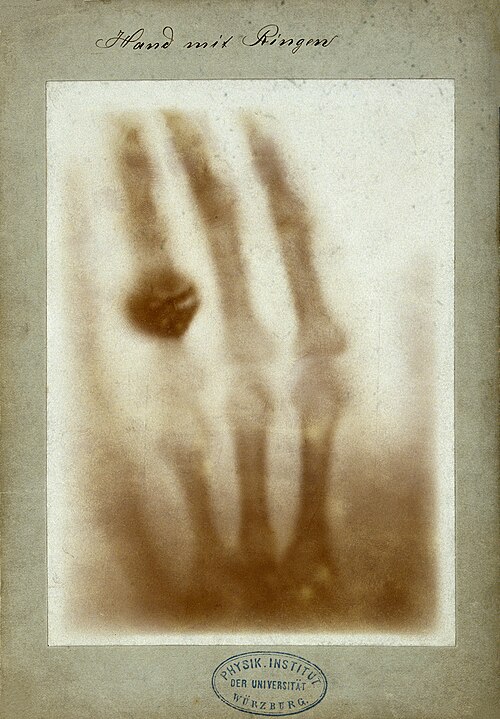
Hand mit Ringen (Hand with Rings): print of Wilhelm Röntgen's first "medical" X-ray, of his wife's hand, taken on 22 December 1895, and presented to Ludwig Zehnder of the Physik Institut, University of Freiburg, on January 1, 1896
Wilhelm Röntgen
Videos
Wilhelm Conrad Röntgen was a German experimental physicist who produced and detected electromagnetic radiation in a wavelength range known as X-rays. In 1901, Röntgen became the first recipient of the
X-ray
…3×10¹⁶ Hz to 3×10¹⁹ Hz) and photon energies in the range of 100 eV to 100 keV, respectively. X-rays were discovered in 1895 by the German scientist Wilhelm Conrad Röntgen, who named it X-radiation to signify an unknown type of radiation. X-rays can penetrate many solid substances such as construction materials and living…

Röntgen in 1900

The house in Remscheid-Lennep, Germany, where Röntgen was born.

Grave of Wilhelm Röntgen (and relatives) in Alter Friedhof in Giessen.

X-ray by Röntgen of Albert von Kölliker's hand.