Yeoman
Videos
The yeoman social class of medieval and early modern England ranked between the peasantry and the landed gentry. The class was first documented in mid-14th century England, where it included people wh

Edith of Wilton, from a 13th-century illuminated manuscript
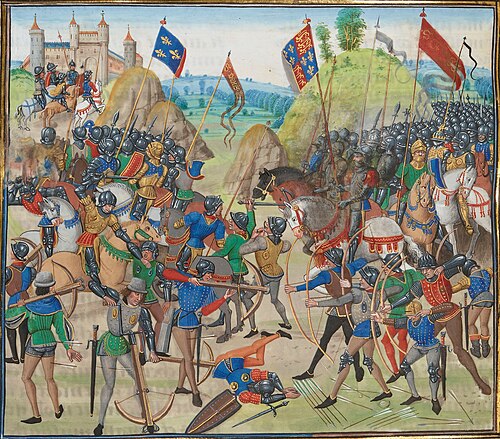
Battle of Crécy, as depicted in a 15th-century illuminated manuscript of Jean Froissart's Chronicles. Both armies are shown stylistically; archers in the foreground. English archers are shown with the legendary longbow, while the Italian mercenaries struggle with their crossbows.
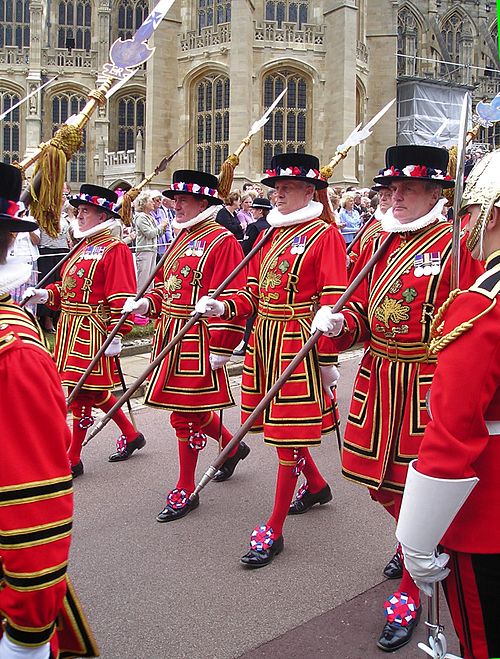
Yeomen of the Guard in procession. Their uniform has remained relatively unchanged since the Tudor dynasty. The spears are carried in remembrance of their role in protecting Henry Tudor at Bosworth Field.

Seal of the port of Dunwich. This is an earlier ship (note the side rudder) which has been retro-fitted with a forecastle, aftcastle, and topcastle. The forecastle and aftcastle platforms are tall enough so men can stand underneath them.
English longbow
Videos
The English longbow was a powerful medieval type of bow, about 6 ft long. While it is debated whether it originated in England or in Wales from the Welsh bow, by the 14th century the longbow was being
Yeoman
…their own land as well as the middle ranks of servants in an English royal or noble household. The 14th century witnessed the rise of the yeoman longbowmen during the Hundred Years' War, and the yeoman outlaws celebrated in the Robin Hood ballads. Yeomen joined the English Navy during the Hundred Years…

Self-yew English longbow, 6 ft 6 in (1.98 m) long , 470 N (105 lbf) draw force.

Self (bottom) and laminated (top) bows for comparison
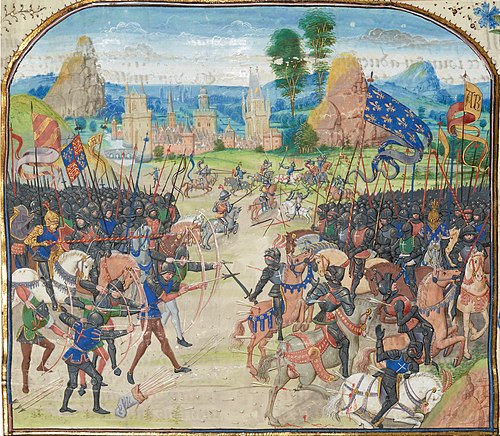
Archers at the Battle of Poitiers, 1356