Yotsuya Kaidan (四谷怪談), the story of Oiwa and Tamiya Iemon, is a tale of betrayal, murder and ghostly revenge. Arguably the most famous Japanese ghost story of all time, it has been adapted for film over 30 times and continues to be an influence on Japanese horror today. Written in 1825 by Tsuruya Nanboku IV as a kabuki play, the original title was Tōkaidō Yotsuya Kaidan . It is now generally shortened, and loosely translates as Ghost Story of Yotsuya.
Utagawa Kuniyoshi's portrait of Oiwa.
Hokusai's image of Oiwa emerging from the Lantern.
In Japanese traditional beliefs and literature, onryō are a type of ghost believed to be capable of causing harm in the world of the living, injuring or killing enemies, or even causing natural disasters to exact vengeance to "redress" the wrongs it received while alive, then taking their spirits from their dying bodies. Onryō are often depicted as wronged women, who are traumatized, envied, disappointed, bitter, or just furious by what happened during life and exact revenge in death. These kinds of ghosts appear extremely vengeful, ruthless, heartless, brutal, cruel, deranged, egotistical, selfish, bloodthirsty, and cold-hearted.
Ukiyo-e by Utagawa Yoshitsuya depicts the moment when Emperor Sutoku, who died in exile, became an onryō.
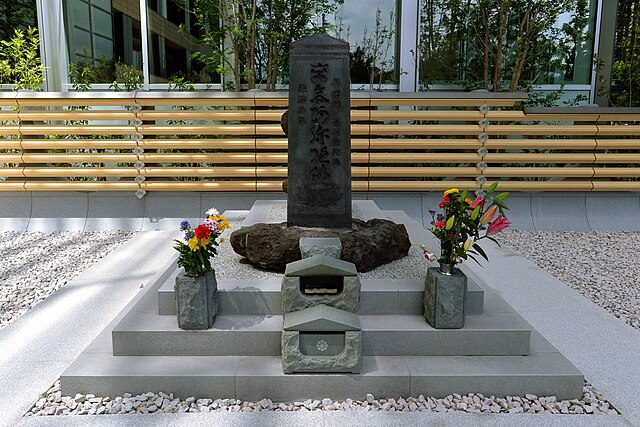
The headstone of Taira no Masakado, located between the skyscrapers of Ōtemachi near Tokyo Station, was renovated in 2021 when the surrounding skyscrapers were rebuilt, but the headstone was never moved.
Ukiyo-e by Tsukioka Yoshitoshi depicting Sugawara no Michizane as the Tenjin (kami of thunder.). After Sugawara no Michizane's death, lightning struck the palace, killing and injuring many of the powerful people involved in his banishment, and Sugawara no Michizane was enshrined in the Tenmangū (Shinto shrines) as the Tenjin.
Onryō from the Kinsei-Kaidan-Shimoyonohoshi (近世怪談霜夜星)