Yuan poetry refers to those types or styles of poetry particularly associated with the era of the Yuan dynasty (1271–1368), in China. Although the poetic forms of past literature were continued, the Yuan period is particularly known for the development of the poetic aspects included in the complex mix of different art forms which characterize Chinese opera, namely the qu or fixed-tone pattern type of verses that were delivered by the actors of these shows. Although the language of Yuan poetry is still generally considered to be Classical Chinese, a certain vernacular aspect reflecting linguistic changes can be seen in some of the fixed-rhythm verse forms, such as Yuan ci and qu. Certain aspects of Yuan poetry can be understood in the context of the social and political changes which took place as part of the process of the Mongol conquest of the Jin and Song Dynasties and their subsequent establishment of the Yuan dynasty.
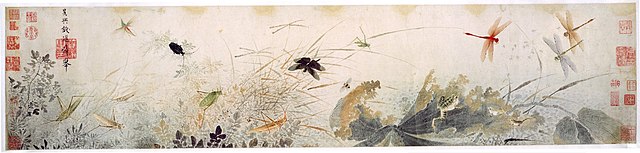
Qian Xuan – Early Autumn
Woodblock edition of a zaju play entitled Zhuye Zhou.
In mid Imperial China, characters in theatrical performances wore elaborate costumes and stereotyped facial makeup, shown here in a large Yuan dynasty (1279–1368 AD) mural in a hall of the Guangsheng Temple in Hongtong, Shanxi province.
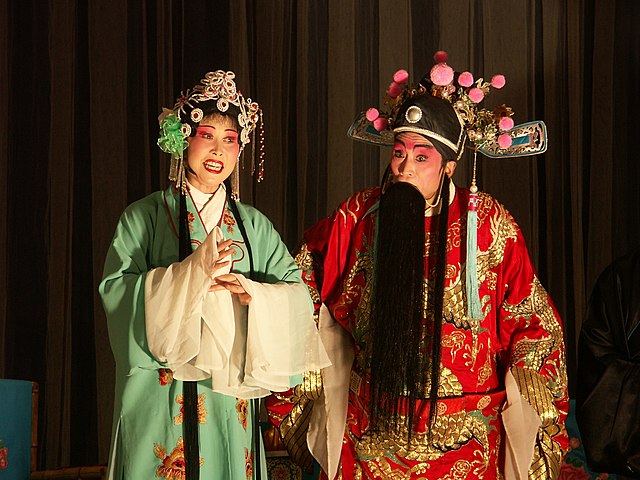
Chinese Opera is a form of theatre in China that combines singing, acting, and elaborate costumes. Topics are based on Chinese history, mythology, and literature. Over its historical evolution, it has incorporated various art forms such as music, song and dance, martial arts, acrobatics, costume and make-up art, and literature. It has highly formalized roles, performed by professional actors each trained for specific roles. Exaggerated features and colors make the roles easily identifiable.
A Shao opera performance in Shanghai, China, 2014. This photo shows an acrobatic performer's somersault.
12th century painting by Su Hanchen; a girl waves a peacock feather banner like the one used in Song dynasty dramatical theater to signal an acting leader of troops
Theatre play, Prosperous Suzhou by Xu Yang, 1759
Sichuan opera in Chengdu