Zecca of Venice
Videos
The Zecca is a sixteenth-century building in Venice, Italy which once housed the mint of the Republic of Venice. Built between 1536 and 1548, the heavily rusticated stone structure, originally with on

Main façade

Detail from woodcut Peregrinatio in Terram Sanctam by Erhard Reuwich (1486), showing the earlier mint (shaded) in Saint Mark's Square.

Tintoretto, Portrait of Jacopo Sansovino (before 1546), Florence, Galleria degli Uffizi. The architect also served as consultant architect for the construction of the Zecca to draw up contracts and to resolve all design-related matters.
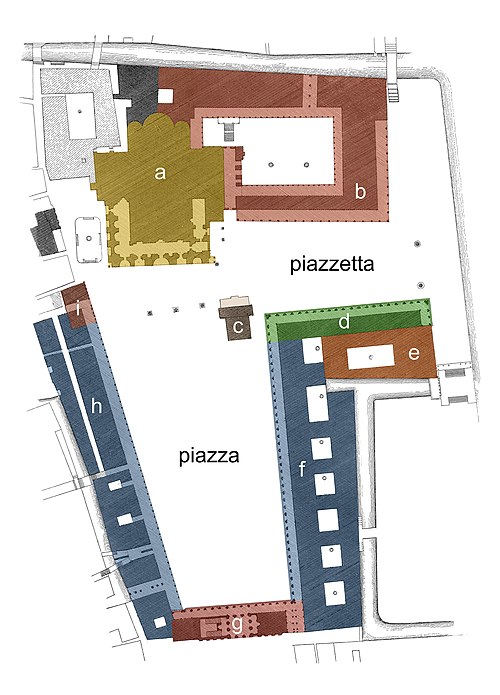
a. St Mark's Basilica b. Ducal Palace c. Bell tower and Loggetta d. Marciana Library e. Mint f. Procuratie Nuove g. Napoleonic wing h. Procuratie Vecchie i. Clock tower
Procuratie
Videos
The Procuratie are three connected buildings along the perimeter of Saint Mark's Square in Venice, Italy. Two of the buildings, the Procuratie Vecchie and the Procuratie Nuove, were constructed by the
Zecca of Venice
…consultant architect and buildings manager) of the procurators of Saint Mark de supra, had already supervised the final stages in the construction of the Procuratie vecchie in Saint Mark's Square following the death of his predecessor Pietro Bon, but the mint was his first major commission in Venice. Independently of the…

view of Saint Mark's Square Procuratie Nuove (left), Procuratie Nuovissime (centre), and Procuratie Vecchie (right)

Tintoretto, Portrait of Procurator Antonio Cappello (c. 1561). One of the major proponents of urban renewal of Saint Mark's Square, Cappello was elected procurator de supra in 1523, at the age of only 29, following the payment of 8,000 ducats.
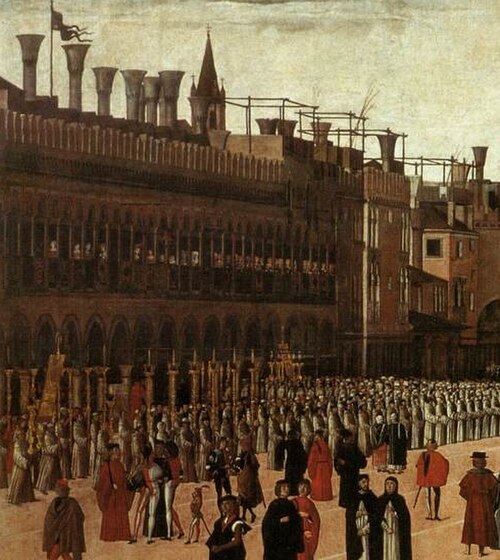
Gentile Bellini, Processione di Corpus Domini in Piazza san Marco (1496). The detail shows the northern side with the twelfth-century building, administered by the procurators de supra, that housed rental apartments and shops.