.223 Remington
Videos
The.223 Remington, also known as 223 Remington by SAAMI and 223 Rem. by the C.I.P., is a rimless, bottlenecked, centerfire intermediate cartridge. It was developed in 1957 by Remington Arms and Fairch

A variety of .223 Remington cartridges with a .308 Winchester (right) for comparison

From left: .222 Remington, .223 Remington, and 5.56×45mm NATO
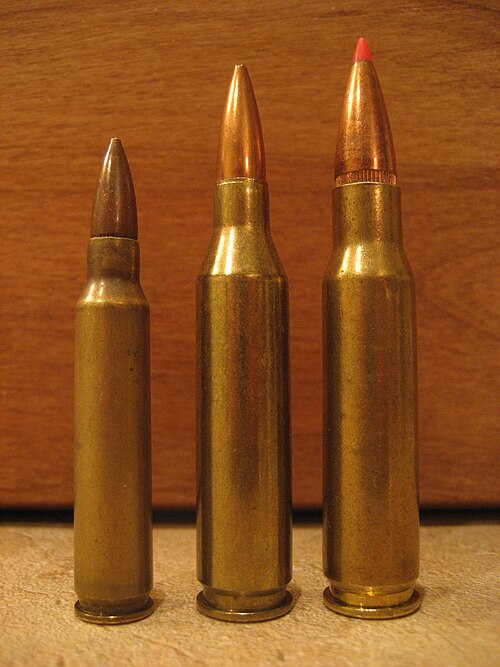
(Left to right) .223 Remington, .243 Winchester, .308 Winchester

10.4mm Swiss Vetterli Winchester
Ruger Mini-14
Videos
The Mini-14 is a lightweight semi-automatic rifle manufactured by Sturm, Ruger & Co. Introduced in 1973, the design was outwardly similar to the M14 rifle and is, in appearance, a scaled-down version
.223 Remington
…one of the most popular cartridges. It is used in a wide range of semiautomatic and manual-action rifles and even handguns, such as the Colt AR-15, Ruger Mini-14, Remington Model 700. For example, the cartridge has become widely used in the US, significantly reducing the prevalence of other similar .22 caliber…

The Mini-14 Government Barrel with sling

Stainless steel Mini-14 Tactical Rifle with various accessories

Ruger Mini-14 Ranch Rifle with a Bushnell 3-9 X 40mm rifle scope

A stainless Mini-14 Tactical (top) and Mini-14 GB-F