2M1510
Videos
2M1510 is a triple or possibly quadruple system of gravitationally bound brown dwarfs, consisting of the eclipsing binary 2M1510AB and the wide companion 2M1510C. 2M1510AB was found to be an eclipsing

The two red "stars" in the center of the image are 2M1510AB (upper left) and 2M1510C (lower right) Credit: Legacy Surveys / D. Lang (Perimeter Institute) & Meli thev

Orbit of the planet (orange orbit) around the brown dwarf binary 2M1510AB (blue orbits).
Brown dwarf
Videos
Brown dwarfs are substellar objects that have more mass than the biggest gas giant planets, but less than the least massive main-sequence stars. Their mass is approximately 13 to 80 times that of Jupi
2M1510
…2M1510 (full designation: 2MASS J15104761–2818234) is a triple or possibly quadruple system of gravitationally bound brown dwarfs, consisting of the eclipsing binary 2M1510AB and the wide companion 2M1510C. 2M1510AB was found to be an eclipsing binary in the first light data of…

Artist's concept of a T-type brown dwarf
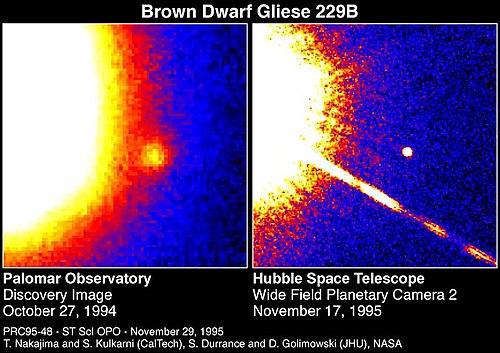
The smaller object is Gliese 229B, about 20 to 50 times the mass of Jupiter, orbiting the star Gliese 229. It is in the constellation Lepus, about 19 light-years from Earth.

Planets, brown dwarfs, stars (not to scale)

A size comparison between the Sun, a young sub-brown dwarf, and Jupiter. As the sub-brown dwarf ages, it will gradually cool and shrink.