Aër
Videos
The Aër is the largest and outermost of the veils covering the Chalice and Diskos in the Eastern Orthodox Church and the Eastern Catholic Churches which follow the Byzantine Rite. It is rectangular in

Aër covering a Chalice and Diskos on the Prothesis

Priest standing at the Holy Table (altar) after the Great Entrance. The Aër has been laid over the chalice and diskos.

Gold-thread embroidered Aer (13th century)

Finely embroidered Aër and smaller cross-shaped veils for the Chalice and Diskos (a mitre stands at the upper left)
Liturgy of Preparation
Videos
The Liturgy of Preparation, also Prothesis or Proskomedia, is the name given in the Eastern Orthodox Church to the act of preparing the bread and wine for the Eucharist.
Aër
…which Christ was wrapped at his Nativity, and also the grave clothes in which he was wrapped at his burial (both themes are found in the text of the Liturgy of Preparation). The Aër is first mentioned by name in an explanation of the Divine Liturgy by a writer of the sixth century, and is also alluded to as "the so-called…
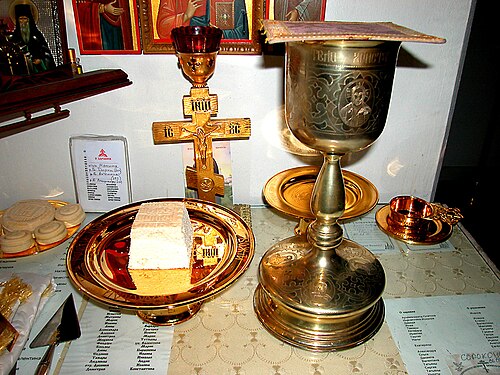
The Altar of Prothesis, set with the diskos (left), chalice (right) and other implements needed for the Liturgy of Preparation. The Lamb sits on the diskos (paten). To the left are Prosphora for the Theotokos, the saints, the living and the departed.
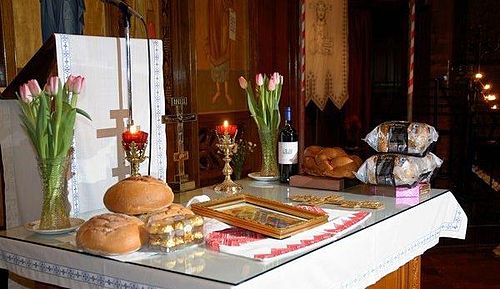
Prosphora prepared for the Liturgy of Preparation. The large loaves on the left are the five principal prosphora; the smaller loaves on the right are for the commemorations of the living and the dead by the faithful (Ukrainian Catholic Cathedral, London).

Liturgy of Preparation just before conclusion

The Lamb and particles placed on the diskos. The large triangle to the viewer's left of the Lamb is the particle for the Theotokos; to the right of the Lamb are the particles for the nine ranks (saints); below the Lamb are the particles commemorating the living and the departed.