AB Aurigae b
Videos
AB Aurigae b is a directly imaged protoplanet or proto-brown dwarf embedded within the protoplanetary disk of the young, Herbig Ae/Be star AB Aurigae. The system is about 508 light-years away: AB Aur
The inner region of protoplanetary disk of AB Aurigae as seen by the SPHERE instrument of the VLT in polarised light. It also shows the very-bright-yellow ‘twist’ where a planet is believed to be forming .


Artist impression of AB Aur b

Webb's First Deep Field

Stacked image of Dimorphos true orientation
Nebular hypothesis
Videos
The nebular hypothesis is the most widely accepted model in the field of cosmogony to explain the formation and evolution of the Solar System. It suggests the Solar System was formed from gas and dust
Dusty disks surrounding nearby young stars in greater detail.


The visible-light (left) and infrared (right) views of the Trifid Nebula—a giant star-forming cloud of gas and dust located 5,400 light-years away in the constellation Sagittarius

Infrared image of the molecular outflow from an otherwise hidden newborn star HH 46/47
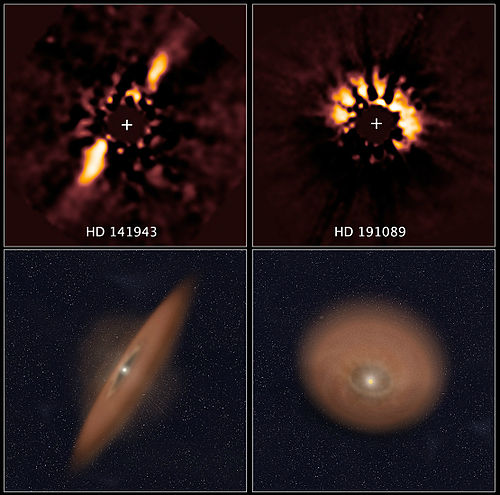
Debris disks detected in HST archival images of young stars, HD 141943 and HD 191089, using improved imaging processes (24 April 2014).