Nebular hypothesis
Videos
The nebular hypothesis is the most widely accepted model in the field of cosmogony to explain the formation and evolution of the Solar System. It suggests the Solar System was formed from gas and dust
Dusty disks surrounding nearby young stars in greater detail.


The visible-light (left) and infrared (right) views of the Trifid Nebula—a giant star-forming cloud of gas and dust located 5,400 light-years away in the constellation Sagittarius

Infrared image of the molecular outflow from an otherwise hidden newborn star HH 46/47
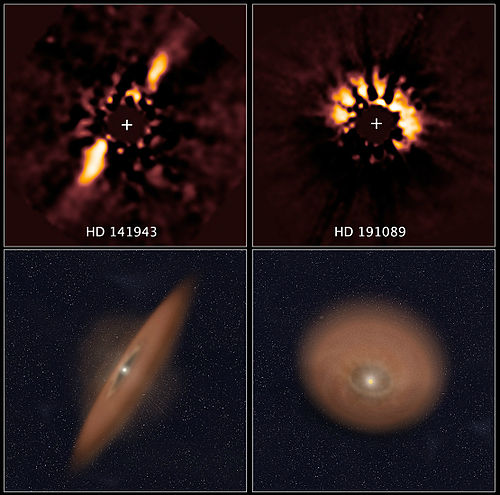
Debris disks detected in HST archival images of young stars, HD 141943 and HD 191089, using improved imaging processes (24 April 2014).
Planet
Videos
A planet is a large, rounded astronomical body that is generally required to be in orbit around a star, stellar remnant, or brown dwarf, and is not one itself. The Solar System has eight planets by th
Nebular hypothesis
…the Heavens, wherein he argued that gaseous clouds (nebulae) slowly rotate, gradually collapse and flatten due to gravity, eventually forming stars and planets. Pierre-Simon Laplace independently developed and proposed a similar model in 1796 in his Exposition du systeme du monde. He envisioned that the Sun…
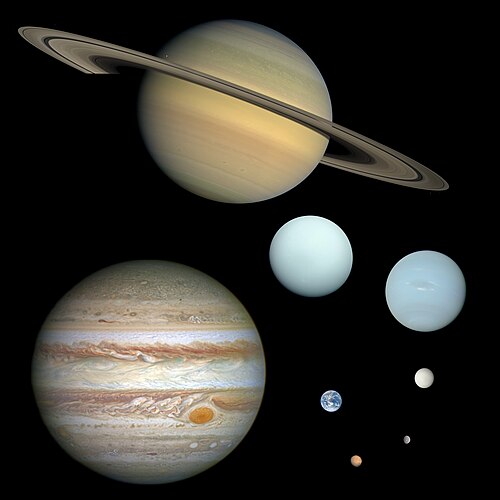
The eight planets of the Solar System with size to scale (up to down, left to right): Saturn, Jupiter, Uranus, Neptune (outer planets), Earth, Venus, Mars, and Mercury (inner planets)

A protoplanetary disk

Protoplanets colliding during planet formation

Earth's atmosphere