Aaru
Videos
Aaru, or the Field of Reeds, is the name for heavenly paradise in Egyptian mythology. Ruled over by Osiris, an Egyptian god, the location has been described as the ka of the Nile Delta.

Sennedjem plows his fields with a pair of oxen, used as beasts of burden and a source of food, a depiction of Aaru from Dayr al-Madīnah.

Depiction of the "Field of Reeds" within the Papyrus of Ani, currently at the British Museum

Ani making an offering before hare, snake and bull headed deities. Behind him stand his wife Thuthu.
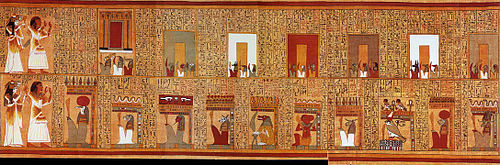
Two 'gate spells'. On the top register, Ani and his wife face the 'seven gates of the House of Osiris'. Below, they encounter ten of the 21 'mysterious portals of the House of Osiris in the Field of Reeds'. All are guarded by unpleasant protectors.
Duat
Videos
The Duat or Tuat is a concept in ancient Egyptian mythology involving death. It is most often seen as a realm where people go after they die. Due to linguistic shifts within Ancient Egypt, the Duat ha
Aaru
…pan and fall into the crocodilian jaws of the goddess Ammit. Any souls that are subject to Ammit's "second death" are doomed to restlessness in the Duat. Qualifying souls undergo a long journey and face many perils before finally reaching Aaru. Once they arrive, they enter through a series of gates—the…
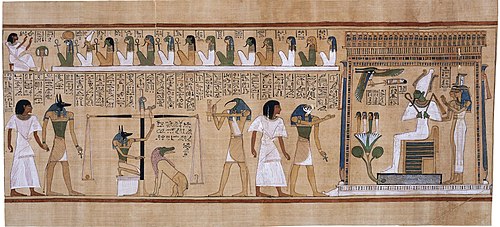
The 'Weighing of the Heart' from the Book of the Dead from the Papyrus of Hunefer, dated to the 19th Dynasty around 1275 BCE. The deceased Hunefer is taken into the judgment hall by the deity Anubis, who weighs a portion of Hunefer's soul, represented by his heart. This ritual is completed with Ammit the Devourer awaiting the result, and Thoth recording. Next, the triumphant Hunefer, having passed the test, is presented by the falcon-headed Horus to

The 42 Judges of Ma'at who sit as jury during the 'Weighing of the Heart'

Af or Afu (commonly known as Afu-Ra), the ram-headed form of Ra when traveling the Duat on the subterrestrial Nile (the 12 hours of night and the underworld) on the Mesektet barque along with Sia (left and front of barque) and Heka (right and behind of barque), surrounded by the protective coiled serpent deity Mehen