Abu Ubayda ibn al-Jarrah
Videos
Abū ʿUbayda ibn al-Jarrāḥ, was a Muslim commander and one of the Companions of the Prophet. He is mostly known for being one of the ten to whom Paradise was promised. He was commander of a large secti
Battle against the Byzantines for Aleppo in 637. Rawdat al-safa (Garden of felicity) by Mirkhwand (d. 1498), Shiraz, 1571-72 (Arthur M. Sackler Collection, S1986.241).

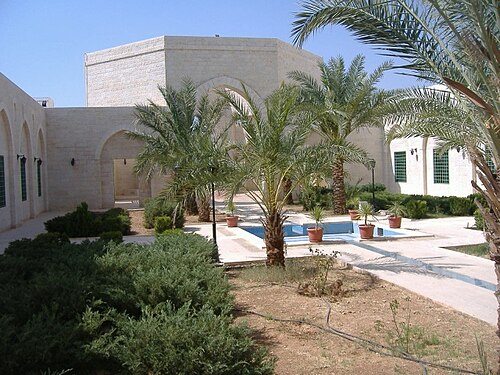
Courtyard of the Mausoleum of Abu Ubaydah in Jordan
Umar
Videos
Umar ibn al-Khattab was the second Rashidun caliph, ruling from August 634 until his assassination in 644. He succeeded Abu Bakr and is regarded as a senior companion and father-in-law of the Islamic
Abu Ubayda ibn al-Jarrah
…one of the ten to whom Paradise was promised. He was commander of a large section of the Rashidun Army during the time of the second Rashidun Caliph Umar and was on the list of Umar's appointed successors to the Caliphate, but died during the Plague of Amwas in 639, five years before Umar's death. Abu…

Calligraphic seal featuring Umar's name, on display in the Hagia Sophia, Istanbul

Sasanid style coins during the Rashidun period, featuring a crescent-star, fire altar, depictions of Khosrow II, and an Arabic bismillāh in the margin). Unlike known historical figures such as Ibn Zubayr and Mu'awiya I, there are no coins minted in the name of these caliphs that could be evidence of political sovereignty.[citation needed]

19th-century colored engraving depicting Umar's entrance into Jerusalem in 638.

Early 20th-century depiction of (Abd al-Rahman ibn Awf or Abdul-Rahman ibn Abi Bakr) witnessing the purported conspiracy of Abu Lu'lu'a, Hormuzan, and Jufayna (wrongly depicted here as a woman; the depiction of the murder weapon may also be wrong) refers to Jufayna as "al-Naṣrānī", indicating that he was a man. Moreover, while the murder weapon seems to be depicted here as a split-blade sword (like Zulfiqar), describes it as "a unique dagger", having "two pointed sharp edges, with a handle in the middle". The picture is taken from