Acqua Felice
Videos
Photos
The Acqua Felice is one of the aqueducts of Rome, completed in 1586 by Pope Sixtus V, whose birth name, which he never fully abandoned, was Felice Peretti. The first new aqueduct of early modern Rome, its source is at the springs at Pantano Borghese, off Via Casilina. Its length is fifteen miles (24 km), running underground for eight miles (13 km) from its source, first in the channel of Aqua Alexandrina, then alternating on the arches of the Aqua Claudia and the Aqua Marcia for seven miles (11 km) to its terminus at the Fontana dell'Acqua Felice on the Quirinal Hill, standing to one side of the Strada Pia, so as to form a piazza in this still new part of Rome. The engineer was Giovanni Fontana, brother of Sixtus' engineer-architect Domenico Fontana, who recorded that the very day the new pope entered the Lateran, he decided that he would bring water once again to the hills of Rome, which had remained waterless and sparsely inhabited, largely by monasteries, since the original ancient aqueducts had been destroyed in the sixth century. From the source, which Sixtus purchased, there was only a very small fall, and the work required an underground conduit as well as an aqueduct carried on arches.

Acqua Felice south of Torre del fiscale

The Fountain of Moses marks the terminus of the acqua Felice on the Quirinal

Moses, by Leonardo Sormani and Prospero Antichi added little to their contemporary reputations

Arco Salette, Vicenza, 1576, attributed to Andrea Palladio, for comparison
Pope Sixtus V
Videos
Photos
Pope Sixtus V, born Felice Piergentile, was head of the Catholic Church and ruler of the Papal States from 24 April 1585 to his death, in August 1590. As a youth, he joined the Franciscan order, where he displayed talents as a scholar and preacher, and enjoyed the patronage of Pius V, who made him a cardinal. As a cardinal, he was known as Cardinal Montalto.

Sixtus V depicted in an anonymous 17th century painting, exhibited in the Albi Cathedral
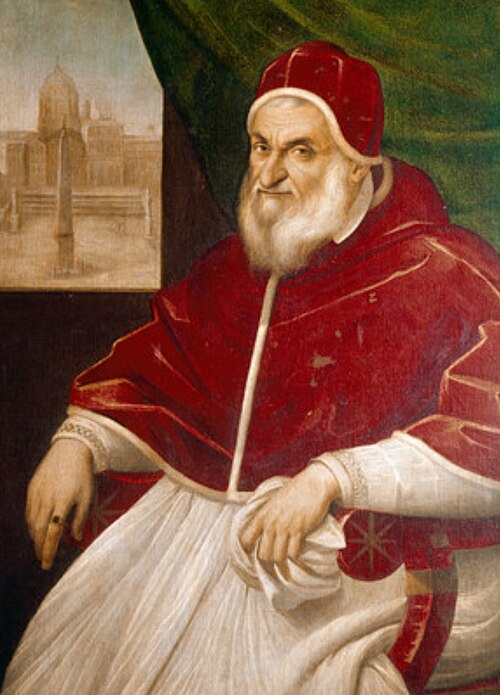
Portrait of Sixtus V in the Vatican Museums

Pope's Cabinet at Stourhead, built for Sixtus V
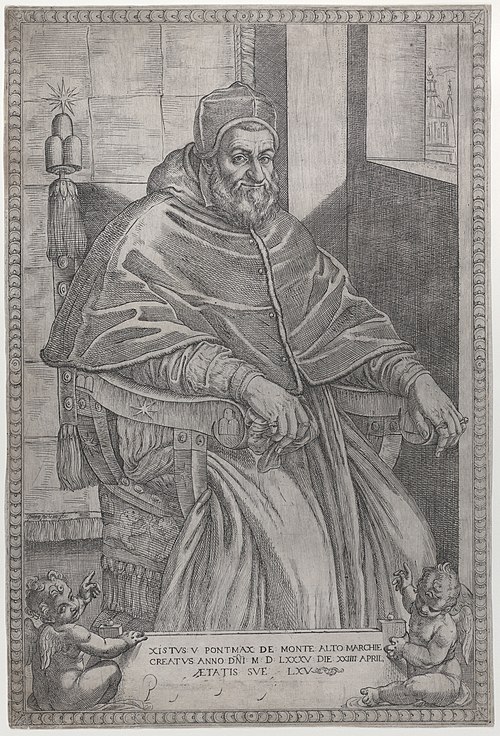
Sixtus V in an engraving of Pietro Facchetti (1585)