Adaptive radiation
Videos
In evolutionary biology, adaptive radiation is a process in which organisms diversify rapidly from an ancestral species into a multitude of new forms, particularly when a change in the environment mak

Four of the 14 finch species found in the Galápagos Archipelago, which are thought to have evolved via an adaptive radiation that diversified their beak shapes, enabling them to exploit different food sources.

An ʻiʻiwi (Drepanis coccinea). Note the long, curved beak for sipping nectar from tubular flowers.

A mixture of blooming and non-blooming Haleakalā silverswords (Argyroxiphium sandwicense macrocephalum).

Darwin's finches by Gould
The Cretaceous–Paleogene extinction event, formerly known as the Cretaceous–Tertiary extinction event, was a major mass extinction of three-quarters of the plant and animal species on Earth which occu
Adaptive radiation
…in isolation since the island split from India some 88 million years ago, and the Mantellidae originated around 50 mya. Older examples are known: the K-Pg extinction event, which caused the disappearance of the dinosaurs and most other reptilian megafauna 65 million years ago, is seen as having triggered a global adaptive…

Discoscaphites iris, an ammonite from the Owl Creek Formation (Upper Cretaceous), in Owl Creek near Ripley, Mississippi

Rudist bivalves from the Late Cretaceous of the Omani Mountains, United Arab Emirates. Scale bar is 10 mm.
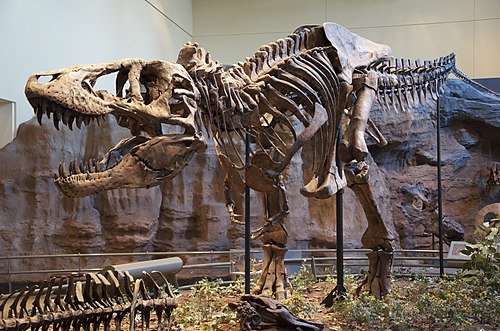
Tyrannosaurus was among the dinosaurs living on Earth before the extinction

Hell Creek Formation