Ecological niche
Videos
In ecology, a niche is the match of a species to a specific environmental condition. It describes how an organism or population responds to the distribution of resources and competitors and how it, in

The flightless dung beetle occupies an ecological niche: exploiting animal droppings as a food source.

The Grinnellian niche can be described as the "needs" niche, or an area that meets the environmental requirements for an organism's survival. Most succulents are native in dry, arid regions like deserts and require large quantities of sun exposure.

Beaver dam in Hesse, Germany. By exploiting the resource of available wood, beavers are affecting biotic conditions for other species that live within their habitat.

The shape of the bill of this purple-throated carib is complementary to the shape of the flower and coevolved with it, enabling it to exploit the nectar as a resource.
Predation
Videos
Predation is a biological interaction in which one organism, the predator, kills and eats another organism, its prey. The predator-prey relationship is one of a family of common feeding behaviours tha
Ecological niche
…how an organism or population responds to the distribution of resources and competitors (for example, by growing when resources are abundant, and when predators, parasites and pathogens are scarce) and how it, in turn, alters those same factors (for example, limiting access to resources by other organisms…
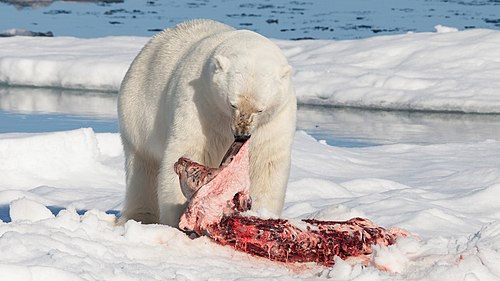
Solitary predator: a polar bear feeds on a bearded seal it has killed.

Social predators: meat ants cooperate to feed on a cicada far larger than themselves.

Spider wasps paralyse and eventually kill their hosts, but are considered parasitoids, not predators.

Carnivorous plant: sundew engulfing an insect