Agelaia multipicta is a swarm-founding, highly eusocial wasp that lives in Mexico, Argentina, Trinidad and southern Brazil. It nests in natural cavities such as hollow trees and aggressively defends the nest from ants, who are brood predators. The workers and queens are morphologically distinguished by ovarian development as well as external features such as a larger petiole and gaster in the queen. Like other carrion-eating (necrophagous) wasp species, A. multipicta plays a scavenging role in the ecosystem. Agelaia multipicta was described by the Irish entomologist Alexander Henry Haliday in 1836.
Agelaia multipicta
A wasp is any insect of the narrow-waisted suborder Apocrita of the order Hymenoptera which is neither a bee nor an ant; this excludes the broad-waisted sawflies (Symphyta), which look somewhat like wasps, but are in a separate suborder. The wasps do not constitute a clade, a complete natural group with a single ancestor, as bees and ants are deeply nested within the wasps, having evolved from wasp ancestors. Wasps that are members of the clade Aculeata can sting their prey.
Wasp
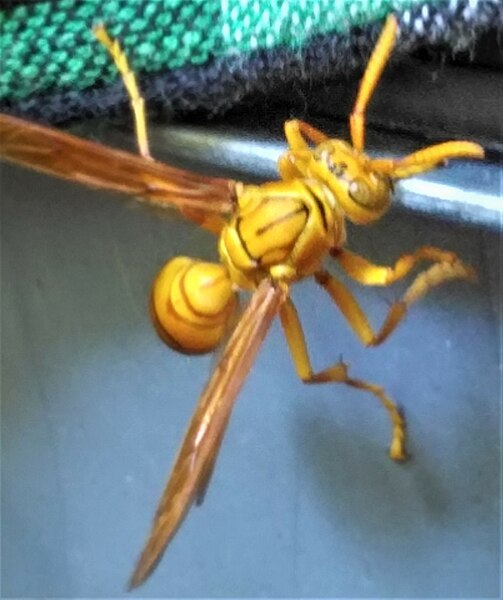
Polistes sp., India
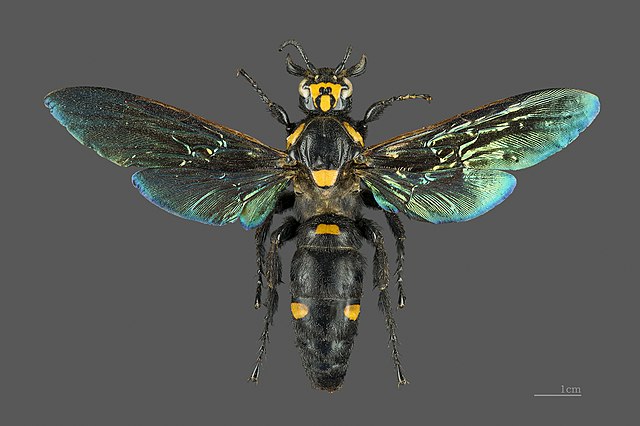
Megascolia procer, a giant solitary species from Java in the Scoliidae. This specimen's length is 77 mm (3.0 in) and its wingspan is 115 mm (4.5 in).
Megarhyssa macrurus, a parasitoid. The body of a female is 50 mm (2.0 in) long, with a c. 100 mm (3.9 in) ovipositor