Air interdiction
Videos
Air interdiction, also known as deep air support, is the use of preventive tactical bombing and strafing by combat aircraft against enemy targets that are not an immediate threat, to delay, disrupt or

A U.S. Navy A-7E Corsair II bombs the Hai Duong bridge in North Vietnam in 1972.

A 4-ship Vic formation of Pakistani F-86F Sabres returning from an interdiction mission during the 1965 war
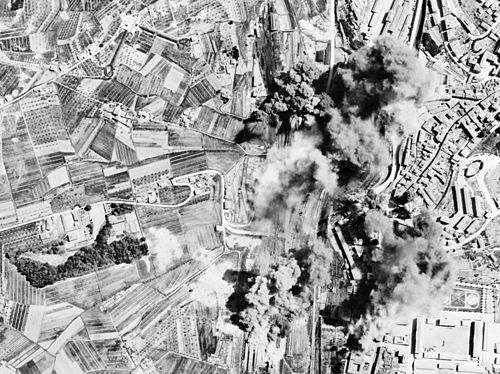
Aerial bombing of German railroad yards at Siena during Operation Strangle by Martin B-26 Marauder medium bombers on April 11 1944, On the alternate line from Pisa and Florence south to Rome, the Siena yards were bombed by Mediterranean Allied Air Force Bombers.

A 388th TFW SAM hunter-killer team refueling on its way to North Vietnam, October 1972
Military aircraft
Videos
A military aircraft is any fixed-wing or rotary-wing aircraft that is operated by a legal or insurrectionary military of any type. Some military aircraft engage directly in aerial warfare, while other

Luchtballon WO I observation balloon

A replica of Messerschmitt Me 262, one of the first turbojet-powered combat aircraft

Sukhoi Su-30 fighter aircraft

AW Apache attack helicopter