Amphidromic point
Videos
An amphidromic point, also called a tidal node, is a geographical location where there is little or no difference in sea height between high tide and low tide; it has zero tidal amplitude for one harm
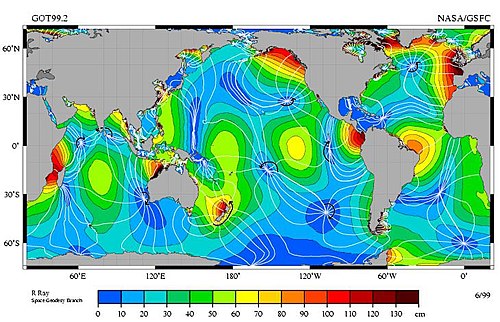
Figure 1. The M2 tidal constituent, the amplitude indicated by color. The white lines are cotidal lines spaced at phase intervals of 30° (a bit over 1 hr). The amphidromic points are the dark blue areas where the lines come together.

Figure 2. Resonance between an incident and reflected wave and the resulting total wave. At certain points (nodes), the amplitude of the incident wave and the reflected wave cancel each other out. At other points (antinodes), the amplitude of the incident wave and the reflected wave amplify each other. The respective distance between the nodes and antinodes are shown in the bottom right of the Figure and expressed in terms of wavelength.

Figure 3. Amphidromic system of the M2 constituent in the North Sea. The light-blue lines are lines of equal tidal phase for the vertical tide (surface elevation) along such a line, and the amphidromic points are denoted by 1, 2 and 3.
Tidal range
Videos
Tidal range is the difference in height between high tide and low tide. Tides are the rise and fall of sea levels caused by gravitational forces exerted by the Moon and Sun, by Earth's rotation and by
Amphidromic point
…there is little or no difference in sea height between high tide and low tide; it has zero tidal amplitude for one harmonic constituent of the tide. The tidal range (the peak-to-peak amplitude, or the height difference between high tide and low tide) for that harmonic constituent increases with distance from this…

Tidal Range