Analog television
Videos
Analog television is the original television technology that uses analog signals to transmit video and audio. In an analog television broadcast, brightness, color, and sound are represented by the amp

Early monochrome analog receiver with large dials for volume control and channel selection, and smaller ones for fine-tuning, brightness, contrast, and horizontal and vertical hold adjustments

Close up image of analog color screen

A waterfall display showing a 20 ms long interlaced PAL frame with high FFT resolution
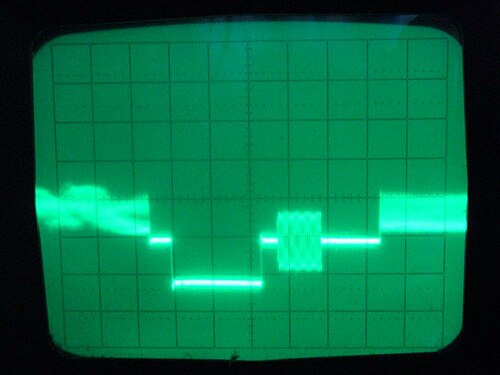
Portion of a PAL video signal. From left to right: end of a video scan line, front porch, horizontal sync pulse, back porch with color burst, and beginning of next line
The digital television transition in the United States was the switchover from analog to exclusively digital broadcasting of terrestrial television programming. It was originally set for between Decem
Analog television
…wholesale switch to digital over-the-air (terrestrial television) broadcasting was Luxembourg in 2006, followed later in 2006 by the Netherlands. The Digital television transition in the United States for high-powered transmission was completed on 12 June 2009, the date that the Federal Communications Commission (FCC) set. Almost two million households…

June 12, 2009 – final hours of analog broadcast on WWL-TV gave information about website and telephone number for more information about transition.

An outdoor high-gain antenna was assumed in planning for DTV reception.