Ancient Greek units of measurement varied according to location and epoch. Systems of ancient weights and measures evolved as needs changed; Solon and other lawgivers also reformed them en bloc. Some units of measurement were found to be convenient for trade within the Mediterranean region and these units became increasingly common to different city states. The calibration and use of measuring devices became more sophisticated. By about 500 BC, Athens had a central depository of official weights and measures, the Tholos, where merchants were required to test their measuring devices against official standards.

Illustration of the Third Horseman of the Apocalypse holding a set of scales; in the Book of Revelation he proclaims "A choinix of wheat for a denarius, and three choinikes of barley for a denarius;" indicating high food prices during a famine.

An obol, Attica, Athens, weighing 0.69g After 449 BC

This section of a frieze from the Elgin Marbles shows a cavalry procession that was part of the quadrennial Greater Panathenaic festival, always held in the month Hekatombion.

Image: Hoplitodromia Louvre CA214
Mile
Videos
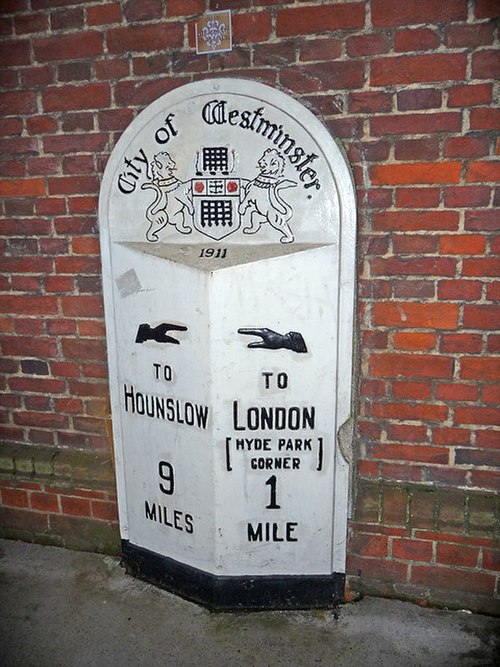
The mile, sometimes the international mile or statute mile to distinguish it from other miles, is a British imperial unit and United States customary unit of distance; both are based on the older English unit of length equal to 5,280 English feet, or 1,760 yards. The statute mile was standardised between the Commonwealth of Nations and the United States by an international agreement in 1959, when it was formally redefined with respect to SI units as exactly 1,609.344 metres.

The supposed remains of the Golden Milestone, the zero-mile marker of the Roman road network, in the Roman Forum

Edinburgh's "Royal Mile"—running from the castle to Holyrood Abbey—is roughly a Scots mile long.

Milestone on Mountbellew Bridge, erected c. 1760. Distances are given in Irish miles.