Ancient drachma
Videos
In ancient Greece, the drachma was an ancient currency unit issued by many city-states during a period of ten centuries, from the Archaic period throughout the Classical period, the Hellenistic period
Above: Six rod-shaped obeloi (oboloi) displayed at the Numismatic Museum of Athens, discovered at Heraion of Argos. Below: grasp of six oboloi forming one drachma.


Athenian silver didrachm of "heraldic type" from the time of Peisistratos, 545–510 BC. Obverse: Four-spoked wheel. Reverse: Incuse square, divided diagonally.
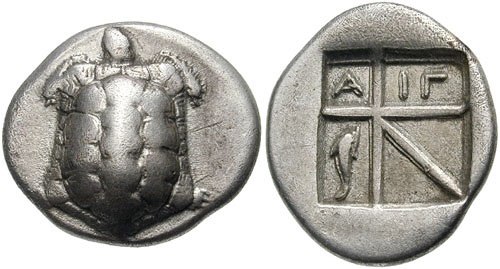
Greek drachma of Aegina. Obverse: Land Chelone / Reverse: ΑΙΓ(ΙΝΑ) and dolphin. The oldest Aegina chelone coins depicted sea turtles and were minted ca. 700–550 BC.
![Silver tetrobol (4/6 of drachma) from Massalia. Obverse: Artemis wearing stephane. Reverse: ΜΑΣΣΑ[ΛΙΗΤΩΝ] (of Massalians), lion standing right.](https://upload.wikimedia.org/wikipedia/commons/thumb/0/01/Massalia-21.jpg/500px-Massalia-21.jpg)
Silver tetrobol (4/6 of drachma) from Massalia. Obverse: Artemis wearing stephane. Reverse: ΜΑΣΣΑ[ΛΙΗΤΩΝ] (of Massalians), lion standing right.
Obol (coin)
Videos
The obol or obolus was a form of ancient Greek currency and weight.
Ancient drachma
…word with the meaning of "handful" or "handle" is found in Linear B tablets of the Mycenean Pylos. Initially a drachma was a fistful (a "grasp") of six oboloí or obeloí (metal sticks, literally "spits") originally used for roasting lamb. With anthropological evidence it is believed that the oboloi were used as a form…


Silver obol of Athens, dated 515–510 BC. Obverse gorgoneion, reverse incuse square.

LUCANIA, Metapontion. c. 425–350 BC. Æ 21 mm.