Archimedean solid
Videos
The Archimedean solids are a set of thirteen convex polyhedra whose faces are regular polygons and are vertex-transitive, although they are not face-transitive and are generally not edge-transitive. T
The Archimedean solids. Two of them are chiral, with both forms shown, making 15 models in all.


Truncated icosahedron in De quinque corporibus regularibus

Rhombicuboctahedron drawn by Leonardo da Vinci

Cuboctahedron in Perspectiva Corporum Regularium
Catalan solid
Videos
The Catalan solids are the dual polyhedra of Archimedean solids. The Archimedean solids are thirteen highly-symmetric polyhedra with regular faces and symmetric vertices. The faces of the Catalan soli
Archimedean solid
…truncated cuboctahedron, truncated icosahedron, truncated dodecahedron, and the truncated tetrahedron. The dual polyhedron of an Archimedean solid is a Catalan solid. The names of Archimedean solids were taken from the Ancient Greek mathematician Archimedes, who discussed them in a now-lost work. Although they were…

Set of Catalan solids

Triakisoctahedron
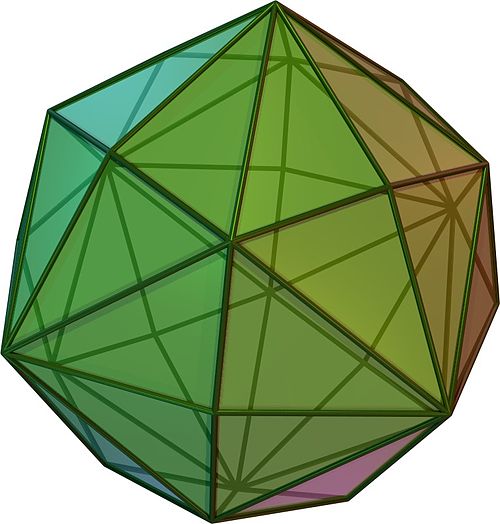
Disdyakisdodecahedron
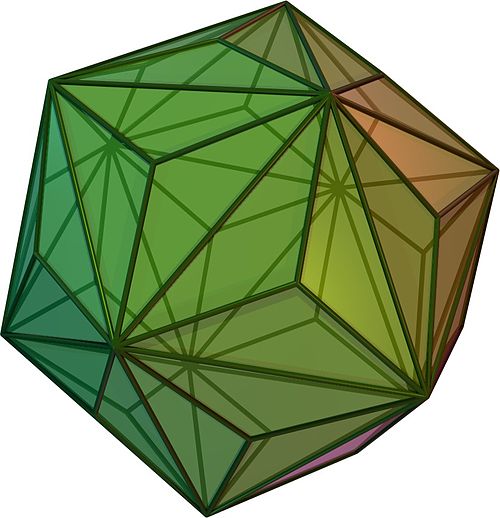
Triakisicosahedron