Art in Nazi Germany
Videos
The Nazi regime in Germany actively promoted and censored forms of art between 1933 and 1945. Upon becoming dictator in 1933, Adolf Hitler gave his personal artistic preference the force of law to a d

Nude statues of the ideal female and male bodies, installed in the streets of Berlin on the occasion of the 1936 Summer Olympics. Berlin won the bid in April 1931, two years before the NSDAP came to power. It was the last time the International Olympic Committee gathered to vote in a city that was bidding.

Ausstellung Deutsche Grafik im Kunstsalon Wolfsberg by Ernst Ludwig Kirchner

Front cover of the guide for the "Degenerate Art Exhibition", 1937. The word "Kunst," meaning art, is in scare quotes; the artwork is Otto Freundlich's sculpture Der Neue Mensch.

Haus der Deutschen Kunst (House of German Art) in Munich. Built in 1933–1937 and designed by Paul Ludwig Troost, with considerable input from Hitler, the Haus was one of the first monumental structures built during the Nazi era.
Joseph Goebbels
Videos
Paul Joseph Goebbels was a German politician and philologist who was the Gauleiter of Berlin, chief propagandist for the Nazi Party, and then Reich Minister of Propaganda from 1933 until his suicide i
Art in Nazi Germany
…and Fritz Lang's Metropolis brought expressionism to cinema. In September 1933, the Reichskulturkammer (Reich Culture Chamber) was established, with Joseph Goebbels, Hitler's Reichsminister für Volksaufklärung und Propaganda (Reich Minister for Public Enlightenment and Propaganda), at its helm. Individual divisions…

Goebbels in 1933

Goebbels speaks at a political rally (1932). This body position, with arms akimbo, was intended to show the speaker as being in a position of authority.
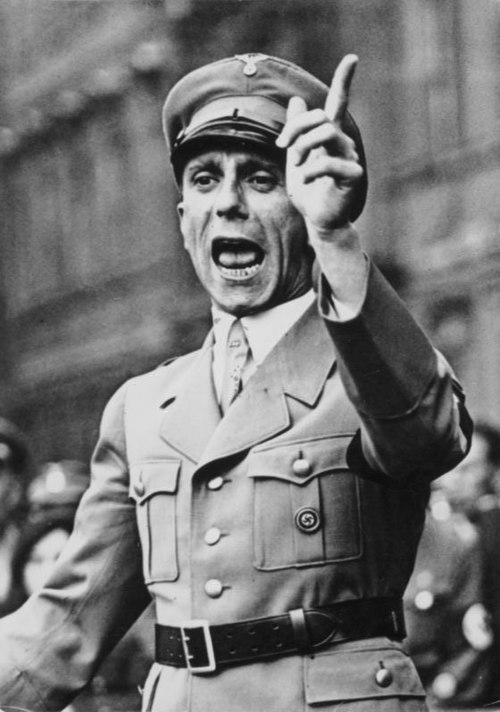
Goebbels giving a speech in Lustgarten, Berlin, August 1934. This hand gesture was used while delivering a warning or threat.

Goebbels used the death of Horst Wessel (pictured) in 1930 as a propaganda tool against "Communist subhumans".