Artemisia I of Caria
Videos
Artemisia I of Caria was a queen of the ancient Greek city-state of Halicarnassus, which is now in Bodrum, Turkey. She was also queen of the nearby islands of Kos, Nisyros and Kalymnos, within the Ach
Painting by German artist Wilhelm von Kaulbach depicting Artemisia shooting arrows at the Greek fleet during the Battle of Salamis, 1868


Coinage of Caria at the time of Artemisia (c. 480–460 BC).

Coinage of Kaunos, Caria at the end of Artemisia's rule, and beginning of the rule of her son Pisindelis. Obv: Winged female figure running right, head left, holding kerykeion in her right hand, and a victory wreath in left. Rev: Baetyl in incuse square. Circa 470–450 BC.
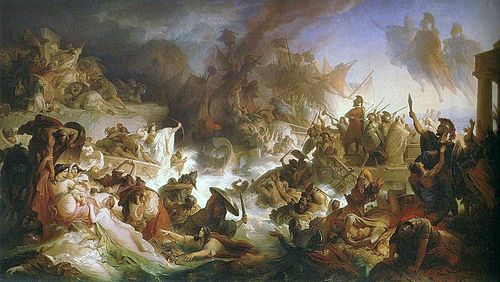
Battle of Salamis (Die Seeschlacht bei Salamis). Artemisia appears highlighted center-left of the painting, above the victorious Greek fleet, below the throne of Xerxes, and shooting arrows at the Greeks. Wilhelm von Kaulbach.
Halicarnassus
Videos
Halicarnassus was an ancient city in Caria, in Anatolia. It was located in southwest Caria, on an advantageous site on the Gulf of Gökova, which is now in Bodrum, Turkey. The city was famous for the M
Artemisia I of Caria
…Artemisia I of Caria (Ancient Greek: Ἀρτεμισία, transl. Ártemisía; fl. 480 BC) was a queen of the ancient Greek city-state of Halicarnassus, which is now in Bodrum, Turkey. She was also queen of the nearby islands of Kos, Nisyros and Kalymnos, within the Achaemenid satrapy of Caria, in about…

The ruins of the Mausoleum at Halicarnassus, one of the Seven Wonders of the Ancient World.

Relief of an Amazonomachy from the Mausoleum at Halicarnassus.

Myndos Gate. Ruins of the fortifications of Halicarnassus (modern Bodrum); 4th c. BC;

Herodotus (Greek: Ἡρόδοτος) is honored with a statue in his home of Halicarnassus (modern Bodrum).