Arthropod eye
Videos
Apposition eyes are the most common form of eye, and are presumably the ancestral form of compound eye. They are found in all arthropod groups, although they may have evolved more than once within thi

Insects and all mandibulates have compound eyes, with the exception of some myriapods that have stemmata.

The male Tabanus lineola has holoptic compound eyes, with the dorsal ommatidia larger than the ventral ommatidia.

In some male mayflies the eyes are split into separate organs for distinct visual functions.

Stalked dichoptic eyes of a River Crab are typical of mature larger Crustacea. The reflection of the photographer in different regions of the surface of each eye indicate the basis for stereoscopic vision.
Arthropod
Videos
Arthropods are invertebrates in the phylum Arthropoda. They possess an exoskeleton with a cuticle made of chitin, often mineralised with calcium carbonate, a body with differentiated segments, and pai
Arthropod eye
…Apposition eyes are the most common form of eye, and are presumably the ancestral form of compound eye. They are found in all arthropod groups, although they may have evolved more than once within this phylum. Some annelids and bivalves also have apposition eyes. They are also possessed…
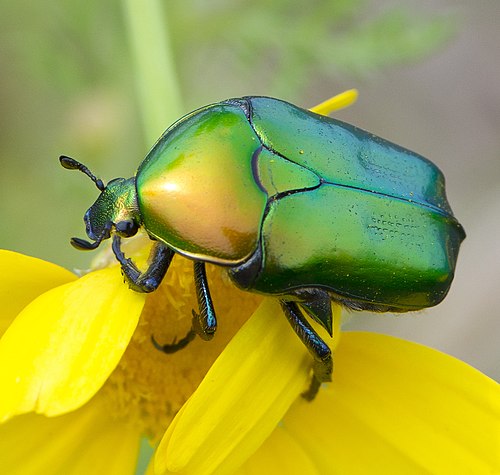
Protaetia cuprea (copper chafer). Beetles are the most diverse order of arthropods.

A cicada climbing out of its exuvia while attached to tree

Long bristles (setae) of a Tliltocatl albopilosus tarantula

Head of a wasp with three ocelli (centre), and compound eyes at the left and right