Aseismic creep
Videos
In geology, aseismic creep or fault creep is measurable surface displacement along a fault in the absence of notable earthquakes. Aseismic creep may also occur as "after-slip" days to years after an e
A house sitting on the Calaveras Fault in 2003. It was demolished in 2009.


Simulation of aseismic creep in Parkfield, California. (The plaques were erected as they appear here in 1995 to represent the fault's movement since 1931.)

Creep of the Hayward Fault displaced this curb over 15 years (Fremont, California).

Offset in the California Memorial Stadium.
Hayward Fault Zone
Videos
The Hayward Fault Zone is a right-lateral strike-slip geologic fault zone capable of generating destructive earthquakes. The fault was first named in the Lawson Report of the 1906 San Francisco Earthq
Aseismic creep
…may also occur as "after-slip" days to years after an earthquake. Notable examples of aseismic slip include faults in California (e.g. Calaveras Fault, Hayward Fault, and San Andreas Fault). Aseismic creep accommodates far-field motions on localized zones of deformation at tectonic plate boundaries. The underlying…

Preferential groundwater flow along the fault emerges as a spring supporting the riparian vegetation in the center of this photo of Taylor Mountain Regional Park. The spring is the source of Cooper Creek which flows northward through a deeply incised canyon along the fault on the southern edge of Santa Rosa, California, to a confluence with Matanzas Creek at Doyle Community Park.
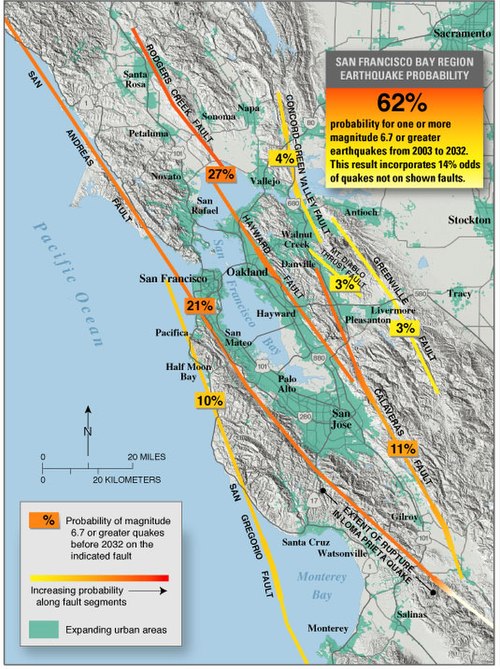
San Francisco Bay region earthquake probability

Eastshore Freeway