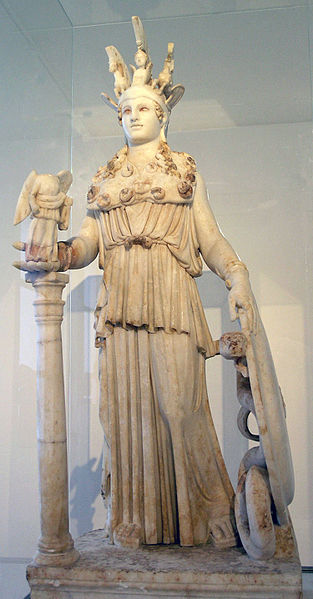
The statue of Athena Parthenos was a monumental chryselephantine sculpture of the goddess Athena. Attributed to Phidias and dated to the mid-fifth century BCE, it was an offering from the city of Athens to Athena, its tutelary deity. The naos of the Parthenon on the acropolis of Athens was designed exclusively to accommodate it.
The Varvakeion Athena reflects the type of the restored Athena Parthenos: Roman period, 2nd century CE (National Archaeological Museum of Athens).
Fragment of the accounts relating to the realization of the statue of Athena Parthenos, IG I3 458, Museum of the Acropolis of Athens.
Medusa Rondanini, Munich Glyptothek, No. 252.
Plaster molding of the "Strangford shield" (Roman copy of the outside of the shield of the Athena Parthenos), Pushkin Museum of Fine Arts.
Ancient Greek includes the forms of the Greek language used in ancient Greece and the ancient world from around 1500 BC to 300 BC. It is often roughly divided into the following periods: Mycenaean Greek, Dark Ages, the Archaic or Epic period, and the Classical period.
An inscription about the construction of the statue of Athena Parthenos in the Parthenon, 440/439 BC
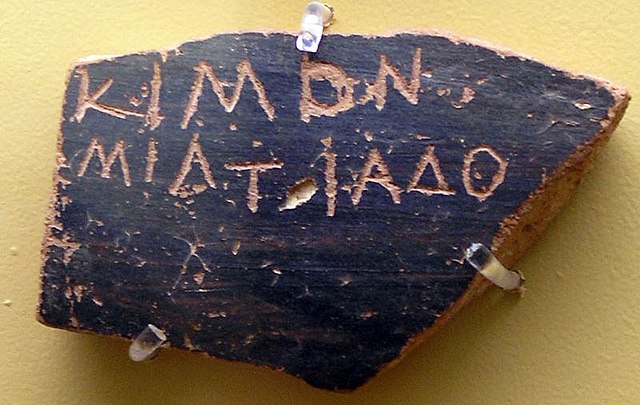
Ostracon bearing the name of Cimon, Stoa of Attalos