Australia–New Zealand relations
Foreign relations between neighbouring countries Australia and New Zealand, also referred to as Trans-Tasman relations, are extremely close. Both countries share a British colonial heritage as antipodean Dominions and settler colonies, and both are part of the core Anglosphere. New Zealand sent representatives to the constitutional conventions which led to the uniting of the six Australian colonies but opted not to join. In the Boer War and in both world wars, New Zealand soldiers fought alongside Australian soldiers. In recent years the Closer Economic Relations free trade agreement and its predecessors have inspired ever-converging economic integration. Despite some shared similarities, the cultures of Australia and New Zealand also have their own sets of differences and there are sometimes differences of opinion which some have declared as symptomatic of sibling rivalry. This often centres upon sports and in commercio-economic tensions, such as those arising from the failure of Ansett Australia and those engendered by the formerly long-standing Australian ban on New Zealand apple imports.
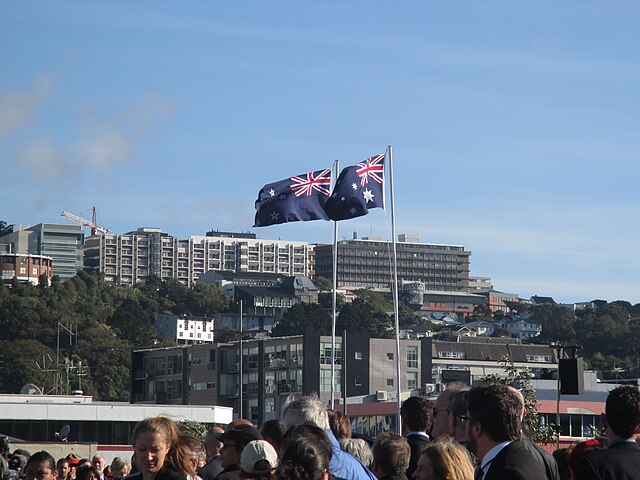
Flags of Australia & New Zealand flying side-by-side
A New Zealand stamp in an Australian travel document
Edward Gibbon Wakefield had a major influence on British plans for colonisation.
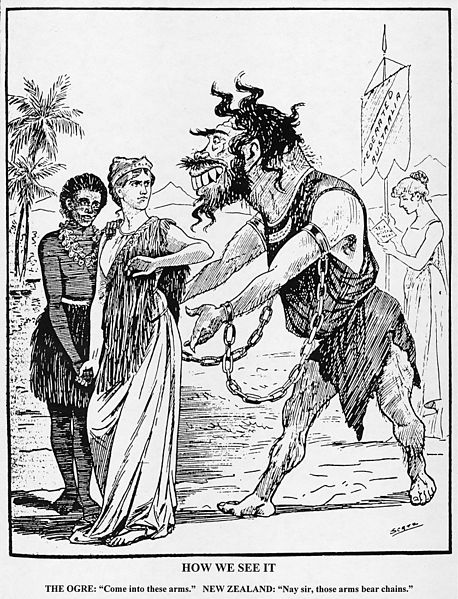
Political cartoon from 1900 that shows the colonies of New Zealand and Fiji rejecting the offer to join the Federation of Australia, with Zealandia referencing the chains as a restraint upon their respective freedoms rather than Australia's origins as a penal colony
New Zealand is an island country in the southwestern Pacific Ocean. It consists of two main landmasses—the North Island and the South Island —and over 700 smaller islands. It is the sixth-largest island country by area and lies east of Australia across the Tasman Sea and south of the islands of New Caledonia, Fiji, and Tonga. The country's varied topography and sharp mountain peaks, including the Southern Alps, owe much to tectonic uplift and volcanic eruptions. New Zealand's capital city is Wellington, and its most populous city is Auckland.
The Waitangi sheet from the Treaty of Waitangi
A meeting of European and Māori residents of Hawke's Bay Province. Engraving, 1863.
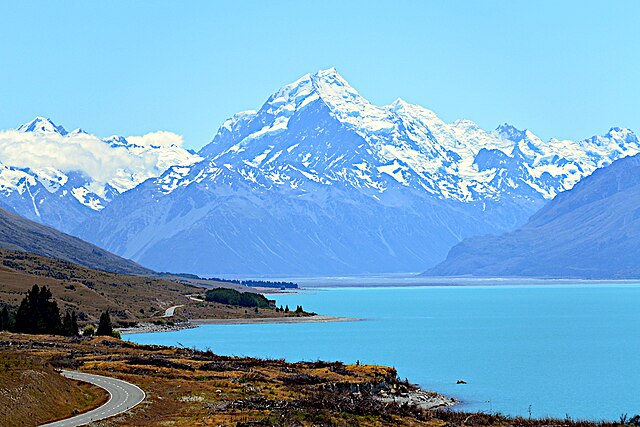
The snow-capped Southern Alps dominate the South Island, while the North Island's Northland Peninsula stretches towards the subtropics.
Aoraki / Mount Cook is the highest point in New Zealand, at 3,724 metres.