Autobracketing
Videos
Autobracketing is a feature of some more advanced cameras, whether film or digital cameras, particularly single-lens reflex cameras, where the camera will take several successive shots with slightly d

A series of images demonstrating a focus bracket. The image on the left shows a single shot taken at .mw-parser-output span.fnumber,.mw-parser-output .fnumber-fallback{display:inline-block;white-space:nowrap;width:max-content}.mw-parser-output span.fnumber::first-letter,.mw-parser-output .fnumber-fallback .first-letter{font-style:italic;font-family:Trebuchet MS,Candara,Georgia,Calibri,Corbel,serif}f/10 with the features of the fly closest to the camera. The center image shows the features farthest from the camera. The image on the right shows
F-number
Videos
An f-number is a measure of the light-gathering ability of an optical system such as a camera lens. It is defined as the ratio of the system's focal length to the diameter of the entrance pupil. The f
A Canon 7 mounted with a 50 mm lens capable of f/0.95

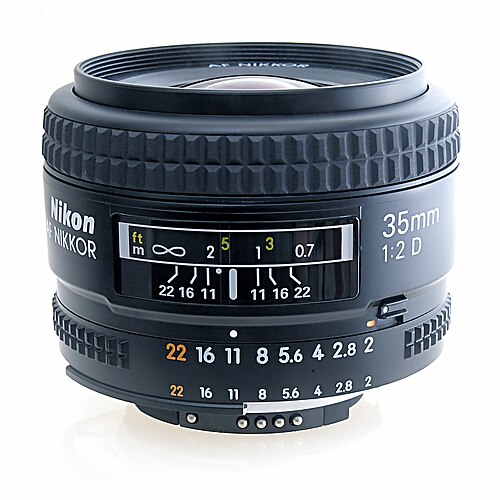
A 35 mm lens set to f/11, as indicated by the white dot above the f-stop scale on the aperture ring. This lens has an aperture range of f/2 to f/22.

Comparison of f/32 (top-left half) and f/5 (bottom-right half)

Shallow focus with a wide open lens