Baal
Videos
Baal, or Ba'al, was a title and honorific meaning "owner" or "lord" in the Northwest Semitic languages spoken in the Levant during antiquity. From its use among people, it came to be applied to gods.
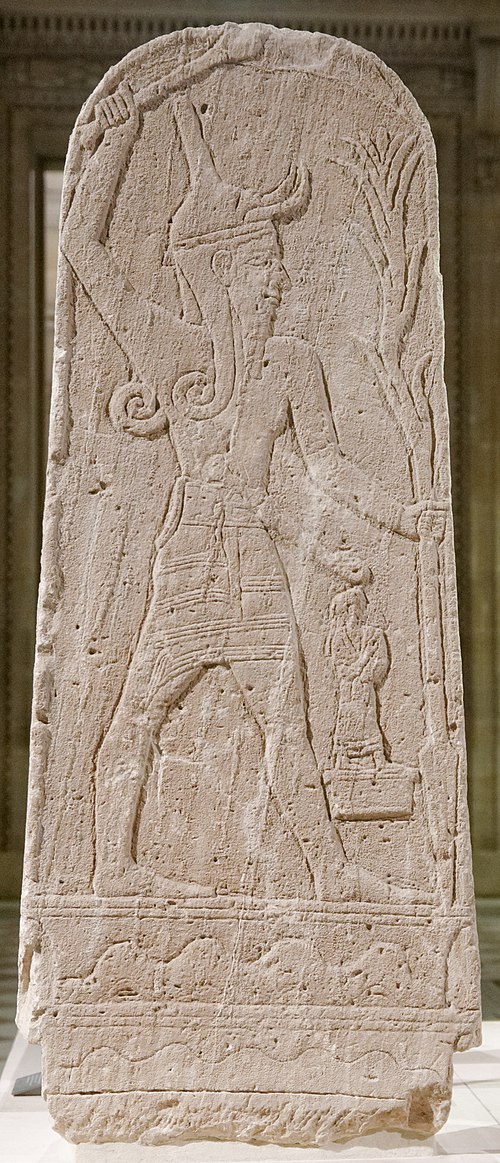
Baal with Thunderbolt stele from Ugarit (Musée du Louvre, Paris)

Bronze figurine of Baal, 14th–12th century BC, found at Ras Shamra (ancient Ugarit) near the Phoenician coast (Musée du Louvre, Paris)

Solid cast bronze of a votive figurine representing Baal discovered at Tel Megiddo, dating to the mid-2nd millennium BC (Institute for the Study of Ancient Cultures, Chicago, Illinois)
Baal Cycle
Videos
The Baal Cycle is an Ugaritic text about the Canaanite god Baʿal, a storm god associated with fertility. It consists of six tablets, itemized as KTU 1.1–1.6. Tablets one and two are about the cosmic b
Baal
…and his local manifestations. The Ugaritic god Baal (𐎁𐎓𐎍) is the protagonist of one of the lengthiest surviving epics from the ancient Near East, the Baal Cycle. Known by epithets like "rider of the clouds" and "Victorious Baal", he was associated with rain, lightning, wind, fertility, and kingship, and was…

Cuneiform tablet of the Baal Cycle

Duck container Louvre AO14779