Babylonia
Videos
Babylonia was an ancient Akkadian-speaking state and cultural area based on the city of Babylon in central-southern Mesopotamia. It emerged as an Akkadian-populated but Amorite-ruled state c. 1894 BC.
Hammurabi (standing), depicted as receiving his royal insignia from Shamash (or possibly Marduk). Hammurabi holds his hands over his mouth as a sign of prayer (relief on the upper part of the stele of Hammurabi's code of laws).


Cylinder seal, c. 18th–17th century BC. Babylonia.

Prism of Sennacherib (705–681 BC), containing records of his military campaigns, culminating with Babylon's destruction. Exhibited at the Oriental Institute of the University of Chicago.

Babylonian prisoners under the surveillance of an Assyrian guard, reign of Ashurbanipal 668–630 BC, Nineveh, British Museum ME 124788
Akkadian Empire
Videos
The Akkadian Empire or the Kingdom of Akkad/Agade was an ancient kingdom established around 2334 BCE, and the first empire in world history, succeeding the long-lived city-states of Sumer. Centered on
Babylonia
…Babylonia was retrospectively called "the country of Akkad" (māt Akkadī in Akkadian), a deliberate archaism in reference to the previous glory of the Akkadian Empire. It was often involved in rivalry with the culturally and linguistically-related state of Assyria in Upper Mesopotamia, which was also an Akkadian-populated…

Bronze head of an Akkadian ruler, discovered in Nineveh in 1931, presumably depicting either Sargon or, more probably, Sargon's grandson Naram-Sin.

Sargon on his victory stele, with a royal hair bun, holding a mace and wearing a flounced royal coat on his left shoulder with a large belt (left), followed by an attendant holding a royal umbrella. The name of Sargon in cuneiform ("King Sargon") appears faintly in front of his face. Louvre Museum.
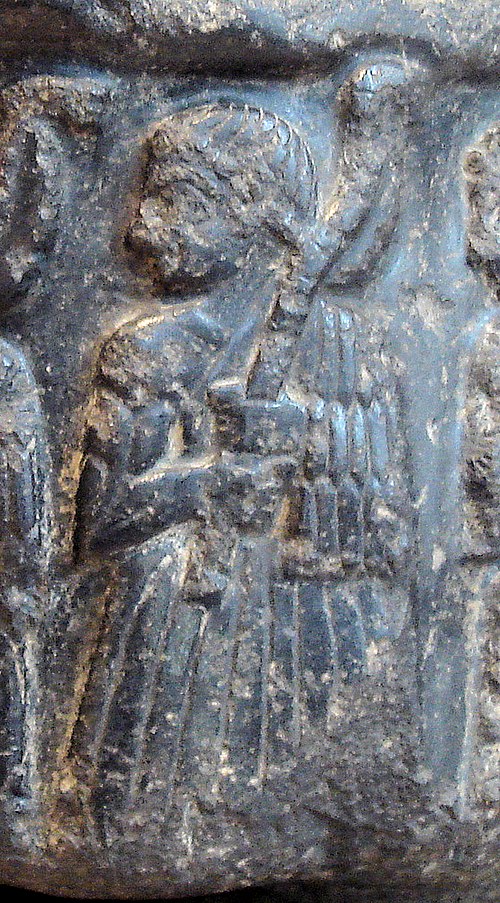
Akkadian official in the retinue of Sargon of Akkad, holding an axe

Prisoners escorted by a soldier, on a victory stele of Sargon of Akkad, circa 2300 BC. The hairstyle of the prisoners (curly hair on top and short hair on the sides) is characteristic of Sumerians, as also seen on the Standard of Ur. Louvre Museum.