Babylonian star catalogues
Videos
Babylonian astronomy collated earlier observations and divinations into sets of Babylonian star catalogues, during and after the Kassite rule over Babylonia. These star catalogues, written in cuneifor

Star list with distance information, Uruk (Iraq), 3200-1500 BC, the list gives each constellation, the number of stars and the distance information to the next constellation in ells.
Pleiades
Videos
The Pleiades, also known as Seven Sisters and Messier 45, is an asterism of an open star cluster containing young B-type stars in the northwest of the constellation Taurus. At a distance of about 444
Babylonian star catalogues
…glyph for "constellation" or "star" in these lists is MUL (𒀯), originally a pictograph of three stars, as it were a triplet of AN signs; e. g. the Pleiades are referred to as a "star cluster" or "star of stars" in the lists, written as MUL.MUL, or MULMUL (𒀯𒀯). The second formal compendium of stars in…
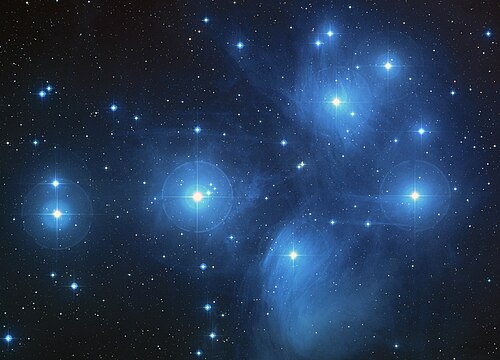
A color-composite image of the Pleiades from the Digitized Sky Survey

On the Nebra sky disc, dated circa 1600 BC, the cluster of seven dots in the upper right portion of the disk is believed to be the Pleiades.

Commemorative silver one dollar coin issued in 2020 by the Royal Australian Mint - on the reverse, the Seven Sisters (Pleiades) are represented as they are portrayed in an ancient story of Australian Indigenous tradition.

Hubble Space Telescope image of reflection nebulosity near Merope (IC 349)