Bagua
Videos
The bagua is a set of symbols from China intended to illustrate the nature of reality as comprising mutually opposing forces reinforcing one another. Bagua is a group of trigrams—composed of three lin
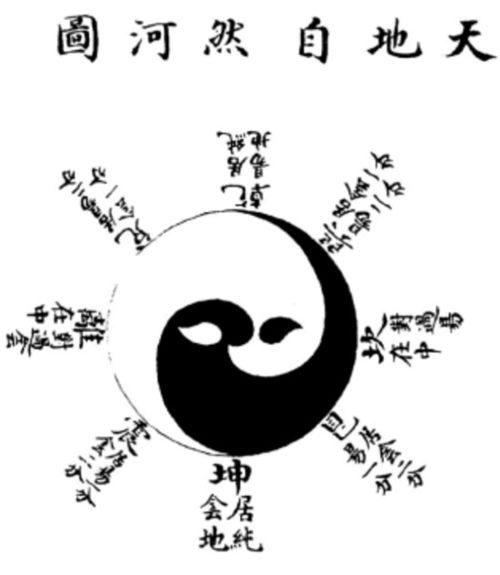
Bagua diagram explanation from Zhao Huiqian's 六書本義; Liùshū běnyì, 1370s

Alternative conversion of the trigrams to binary

Cast bronze Bagua mirror with trigrams decor. Song dynasty, AD 960-1279.

Three variants of modern Bagua mirror talismans sold at a shop. From left to right: Flat, Convex, Concave.
Fuxi
Videos
Fuxi or Fu Hsi is a culture hero in Chinese mythology, credited along with his sister and wife Nüwa with creating humanity and the invention of music, hunting, fishing, domestication, and cooking, as
Bagua
…The bagua can appear singly or in combination, and is commonly encountered in two different arrangements: the Primordial (先天八卦), "Earlier Heaven", or "Fuxi" bagua (伏羲八卦), which is so named according the legend of Fuxi being the first primordial being to identify the eight trigrams; and the Manifested (後天八卦…

Seated portrait depicting Fuxi, painted by Ma Lin of the Song dynasty

Fuxi temple in Xinle, Hebei

Painting of Fuxi looking at a trigram sketch, painted by Guo Xu (郭詡) of the Ming dynasty

Emperor Fuxi, woodcut print by Gan Bozong of the Tang dynasty