Barkhausen–Kurz tube
Videos
The Barkhausen–Kurz tube, also called the retarding-field tube, reflex triode, B–K oscillator, and Barkhausen oscillator, was a high frequency vacuum tube electronic oscillator invented in 1920 by Ger

The first experimental microwave relay system, a 1.7 GHz link 40 miles across the English channel in 1931, used a Barkhausen-Kurz tube mounted at the focus of the 10 foot dish shown. It had a radiated power of about 1⁄2 watt.

UHF Barkhausen Kurz Lecher line transmitter 1933

UHF Barkhausen Kurz Lecher line transmitter 1933 closeup
Klystron
Videos
A klystron is a specialized linear-beam vacuum tube, invented in 1937 by American electrical engineers Russell and Sigurd Varian, which is used as an amplifier for high radio frequencies, from UHF up
Barkhausen–Kurz tube
…Its output power was low, which limited its applications. However it inspired research that led to other more successful transit time tubes such as the klystron, which made the low power Barkhausen-Kurz tube obsolete. The triode vacuum tube developed by Lee de Forest in 1906 was the first device that could…
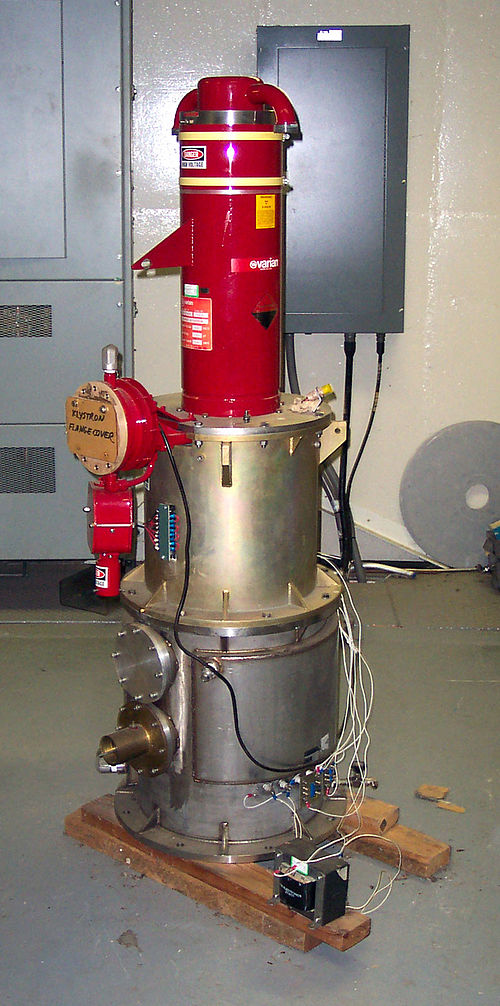
400 kW klystron used for spacecraft communication at the Canberra Deep Space Communications Complex. This is a spare in storage.

5 kW klystron tube used as power amplifier in UHF television transmitter, 1952. When installed, the tube projects through holes in the center of the cavity resonators, with the sides of the cavities making contact with the metal rings on the tube.

The first commercial klystron, manufactured by Westinghouse in 1940. Part of the tube is cut away to show the internal construction. On the left are the cathode and accelerating anode, which create the electron beam. In the center between the wooden supports is the drift tube, surrounded by the two donut-shaped cavity resonators: the "buncher" and the "catcher". The output terminal is visible at top. On the right is the cone shaped collector anode, which absorbs the electrons. It could generate 200

Klystron oscillator from 1944. The electron gun is on the right, the collector on the left. The two cavity resonators are in center, linked by a short coaxial cable to provide positive feedback.