Battle of Diu
Videos
The Battle of Diu was a naval battle fought on 3 February 1509 in the Arabian Sea, in the port of Diu, India, between the Portuguese Empire and a joint fleet of the Sultan of Gujarat, the Mamlûk Burji

Notable victory achieved by the Viceroy D. Francisco de Almeida against the navies of the Sultan of Egypt and the Kings of Cambay and Calicut. Lithograph by Maurício José do Carmo Sendim, 1840

16th-century Mamluks

Portuguese nau. With fore and aft castles integrated in the hull and a deeper draught meant to withstand long trans-oceanic voyages, Portuguese carracks were some of the most seaworthy ships of their time.

Before the heavy galleon, the Portuguese square-rigged caravel was the first fully rigged dedicated warship. It performed mainly as a heavy escort.
Gujarat Sultanate
Videos
The Gujarat Sultanate or Sultanate of Gujarat was a late medieval Indian state in Western India, primarily based in the present-day state of Gujarat. The kingdom was established in 1394 when Muzaffar
Battle of Diu
…rapidly captured several key ports in the Indian Ocean including Goa, Malacca, and Ormuz. The territorial losses crippled the Mamluk Sultanate and the Gujarat Sultanate. The battle catapulted the growth of the Portuguese Empire and established its political dominance for more than a century. The Battle of Diu marked…

Silver Tanka of Nasir al-din Mahmud Shah III, Sultanate of Gujarat.

Death of Bahadur Shah of Gujarat an Ottoman ally at the Siege of Diu. He was killed fighting against the Portuguese in 1537; (Illustration from the Akbarnama, end of 16th century).
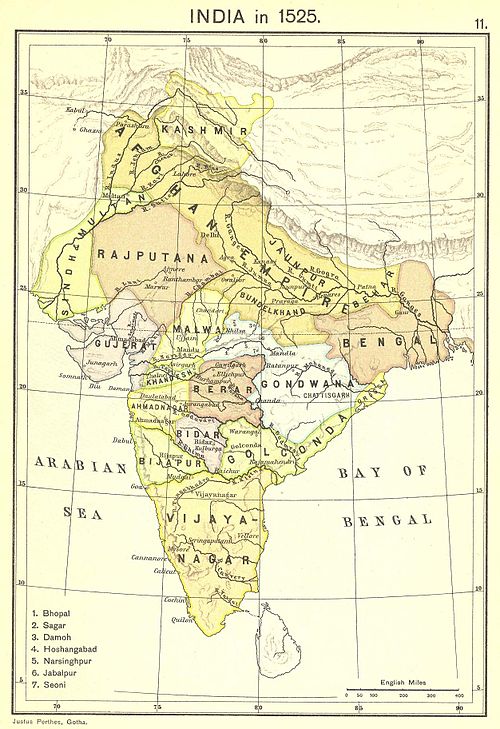
Gujarat Sultanate in 1525

Close up of the gun