Bee
Videos
Bees are winged insects that form a monophyletic clade Anthophila within the superfamily Apoidea of the order Hymenoptera, with over 20,000 known species in seven recognized families. Some species – i

Tetragonula carbonaria

Head of a male carpenter bee, showing antennae, three ocelli, compound eyes, and mouthparts

The lapping mouthparts of a honeybee, showing labium and maxillae

Long-tongued bees and long-tubed flowers coevolved, like this Amegilla species (Apidae) on Acanthus ilicifolius.
Wasp
Videos
A wasp is any insect of the narrow-waisted suborder Apocrita of the order Hymenoptera which is neither a bee nor an ant; this excludes the broad-waisted sawflies, which look somewhat like wasps, but a
Bee
…whereas over 90% of bee species – including mason bees, carpenter bees, leafcutter bees, and sweat bees – are solitary. Unlike the closely related wasps and ants, who are carnivorous/omnivorous, bees are herbivores that specifically feed on nectar (nectarivory) and pollen (palynivory), the former primarily…
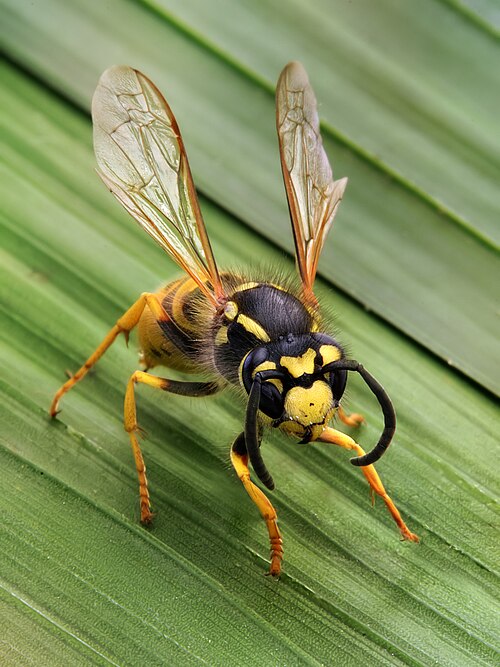
Vespula germanica Richard Bartz

Polistes sp., India

Megascolia procer, a giant solitary species from Java in the Scoliidae. This specimen's length is 77 mm (3.0 in) and its wingspan is 115 mm (4.5 in).
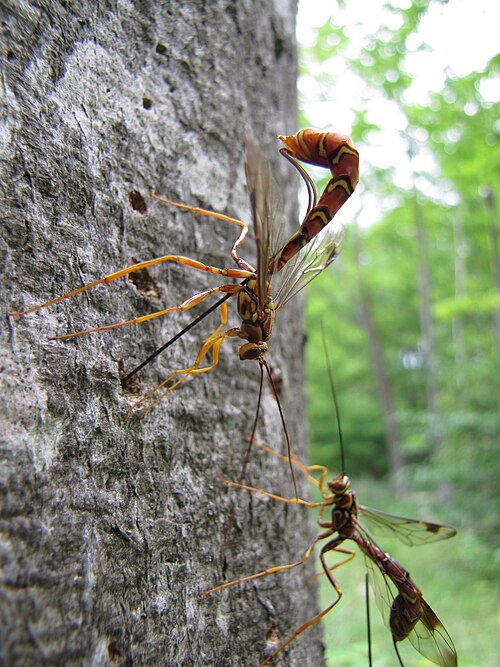
Megarhyssa macrurus, a parasitoid. The body of a female is 50 mm (2.0 in) long, with a c. 100 mm (3.9 in) ovipositor