Behavioral modernity
Videos
Behavioral modernity is a suite of behavioral and cognitive traits associated with humans, reflecting capacities such as abstract and symbolic thought, planning depth, cumulative culture, and complex

Upper Paleolithic (16,000-year-old) cave painting from Lascaux cave in France

The Venus of Hohle Fels figurine was carved about 40,000 years ago and is a product of behavioral modernity

A Māori man performing haka, a ceremonial dance. He is displaying several hallmarks of behavioral modernity including the use of jewelry, application of body paint, music and dance, and symbolic behavior.
Early modern human
Videos
Early modern human, or anatomically modern human, are terms used to distinguish Homo sapiens that are anatomically consistent with the range of phenotypes seen in contemporary humans, from extinct arc
Behavioral modernity
…behavioral modernity is increasingly understood as a mosaic of traits that emerged gradually and were expressed variably across time and populations. Anatomically modern humans possessed much of the necessary neural architecture by at least ~300 thousand years ago, but early populations were small and fragmented, limiting the…

Reconstruction of early Homo sapiens from Jebel Irhoud, Morocco, c. 315,000 years BP

100 to 80 thousand year old Skhul V from Israel

Layer sequence at Ksar Akil in the Levantine corridor, and discovery of two fossils of Homo sapiens, dated to 40,800 to 39,200 years BP for "Egbert", and 42,400–41,700 BP for "Ethelruda".
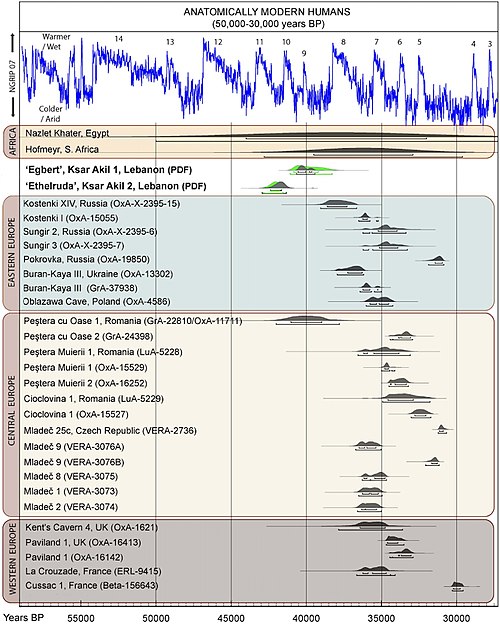
Known archaeological remains of anatomically modern humans in Europe and Africa, directly dated, calibrated carbon dates as of 2013.