Black Ribbon Day
Videos
The Black Ribbon Day, officially known in the European Union as the European Day of Remembrance for Victims of Stalinism and Nazism and also referred to as the Europe-wide Day of Remembrance for the v

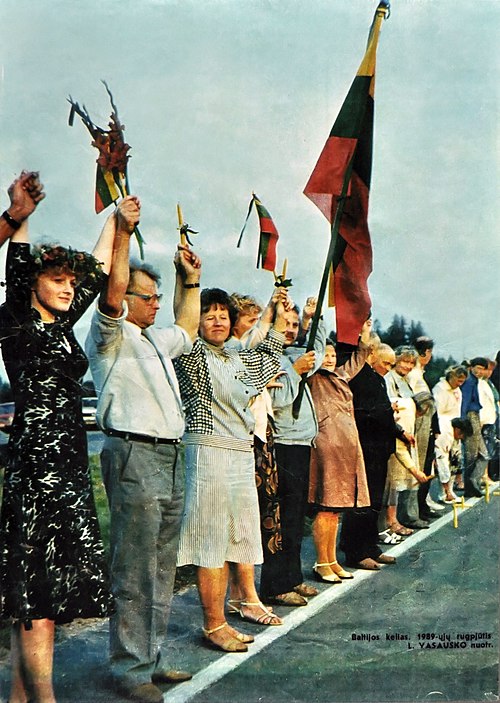
Lithuanians protesting against the Soviet occupation in Panevėžys during the Baltic Way on Black Ribbon Day in 1989

The establishment of the European Day of Remembrance for Victims of Stalinism and Nazism was proposed by Václav Havel (pictured), Joachim Gauck and a group of human rights activists and former political prisoners from Central and Eastern Europe.

Stalin shakes hands with Ribbentrop after the signing of the Molotov–Ribbentrop Pact.

Joachim Gauck, the President of Germany from 2012 to 2017, proposed the remembrance day together with Václav Havel.
Baltic Way
Videos
The Baltic Way or Baltic Chain was a peaceful political demonstration that occurred on 23 August 1989. Approximately two million people joined their hands to form a human chain spanning 675 kilometres
Black Ribbon Day
…in Western countries against the Soviet Union, which gained prominence in the years leading up to the Revolutions of 1989 and that inspired the 1989 Baltic Way, a major demonstration where two million people joined their hands to call for an end to the Soviet occupation. Canadian and other Western communities…
The Baltic Way: The human chain connecting the three Baltic capitals – Tallinn, Riga and Vilnius.

The 23 August 1939 Molotov–Ribbentrop Pact divided "the Baltic States (Finland, Estonia, Latvia, Lithuania)" into German and Soviet "spheres of influence" (German copy)

Poster denouncing the Molotov–Ribbentrop Pact

Diagram assigning each city and town a stretch of the road to cover